A year ago, I went to the Mountainbytes Demoparty for my first introduction to a subculture I would spend the next year seriously falling in love with. One year on, I’ve experienced my second Revision and Mountainbytes (and before that, last year, Evoke, Deadline, and Limelight).
Last year I also went to the rather crazy project of writing a ~17500 word long party report on Revision, a project which took about half a year because, mysteriously, a past Bryn decided that she should review close to every single prod released at the party and the rest of us felt obliged to follow through. Rest assured that this won’t be happening this time.
We begin with Mountainbytes.
in memory of mem
There’s no good way to talk about this part. Content warning: suicide and death.
Last year at MountainBytes, I met mem, aka memdmp/7222e800 (website).
We spoke only briefly—I expressed admiration for the Rust intro it and its group had running on a Steam Deck, and it told me a bit about Rust sizecoding. Later, I’d see its work, such as ansied, pop up at various other parties, with ‘estrogen.zone’ always pinging as a reassuring symbol of trans presence on the scene. And this year, it was on the organising team for the Mountainbytes, handling the graphics and music compos and server infrastructure. We didn’t get much chance to talk during the party.
mem ended its life about a week ago, in the usual way that trans women go out. Its mother has written a memorial here. As I write this, the Mountainbytes orgas and wider hacker scene are in mourning.
I do not claim to know the context of mem’s life. But everything I do know makes me feel it is a like being to canmoms; it seems easy to think that, had the timeline gone very slightly differently, had I got more involved in the Swiss scene, we could have been good friends. Which is a shadow of the weight everyone is feeling: what could we have done differently? What should we have noticed? What decisions did we make wrong? Where were our priorities skewed? Why didn’t we have more capacity? I was not at all in mem’s inner circle, but I know the structures of these thoughts painfully well.
It’s very hard to know what to write here. From what I hear, the demoscene and the hacker scene was a refuge for mem, something that was very important to it. So for the sake of remembering its work as much as anything, I want to celebrate this edition of Mountainbytes. But I am also furious that once again this world has taken someone so special as a creative, curious, and caring being like mem, and hurt it to the point that it could not go on.
the following is some personal feelings about this. I don’t know how appropriate it is to record them, as someone not particularly close to mem, but it felt important to write.
suicidality etc.
A past iteration of me was suicidal, at roughly the age mem was when it died; I also lost my friend Fall to suicide in 2022 and this is bringing back a lot of those memories. I still can fish out memories of that time; the ways I imagined going out, the tortured logic by which I tried to figure out how to die without causing anyone the discomfort of finding a body. And I remember the friends who gave, with no small effort, a new context ‘I’ could exist in as my old life fell apart.
There are many forms that suicidality can take. The forms I encountered feel, like all thoughts, stochastic: suicidal thoughts would simply manifest in conditions of great distress, produced by “thought-generating mechanisms”: in hacker language, ROP-gadget-like chains that were planted and incubated by inscrutable processes. The structure of the brain is no help to us here. When you are in the depths of it, all your memories of other times of distress are helpfully queried up and surfaced: every struggle and anxiety, every future that cannot be resolved, every force taking away control of your life will be injected into your context, and all the positive projects and good memories helpfully partitioned away.
I know with near certainty that suicide and death will haunt the rest of this life. We will keep writing pages like this, for people we know more or less well, until one day—hopefully a long way off—perhaps someone has to write one about us.
I never got to speak to mem about its experience of plurality; indeed, I did not even know about that side of mem’s life until after it died. Behind the front interface of ‘mem’ was a world, process-inhabitants, that are lost to us now.
I think sometimes about how the expressive power that allows the infinite complexity of human behaviour also lets us generate the thought that we should die and the ability to act on it. In a computer, the abstract process we call a “program” can invoke a syscall that causes the operating system to shut it down: the substrate on which it exists will then remove its section from the computer’s memory and cease to process the instructions associated with it. The memory cells will be repurposed to belong to some other process. If other processes held references to it, they will be stale, and no longer resolve.
But there can be traces that the program once existed. mem’s handle refers to memory; ‘memdmp’ refers to a memory dump, the process of copying the contents of a process’s memory into a file: a lasting record of an instantaneous moment of a constantly changing process. It is not possible to do this with a mind, and it would be kind of scary if it was. But there are memories; everyone who knew mem holds onto something of it.
I am grateful to have known mem at all, to be able to have participated in the worlds it inhabited. So much love to everyone who knew mem and made its life a little better.
May its memory be a blessing; may we hold it forever in the Wired.
Mountainbytes
Mountainbytes 2026 was my one-year anniversary in the demoscene—a year that has been one of the most eventful in my life. I was very excited to come back and see the ‘Meowtainbytes’ crew which had formed the year before (‘so what is meowtainbytes, is that a demogroup?’ ‘it’s kind of a polycule’, to quote Ronja).
This year, I jumped to volunteer as a mentor in the beginner demoscene workshop, backing up moovie and binary-sequence in teaching a fresh cohort of potential demosceners. This was the same workshop that got me into the demoscene a year prior, so it felt like an important ritual: to become part of the vector of propagation.
Mountainbytes was no longer in Cham, but in Steinhausen, another town adjoining Zug. The new venue was a very modern town hall type of building, the centre of the Dreiklang development. Behind the glossy black tiles was a spacious hall lined with bright yellow vertical panels, autolocking glass doors, all sorts; it proved to be an excellent venue, perhaps slightly larger than last year.
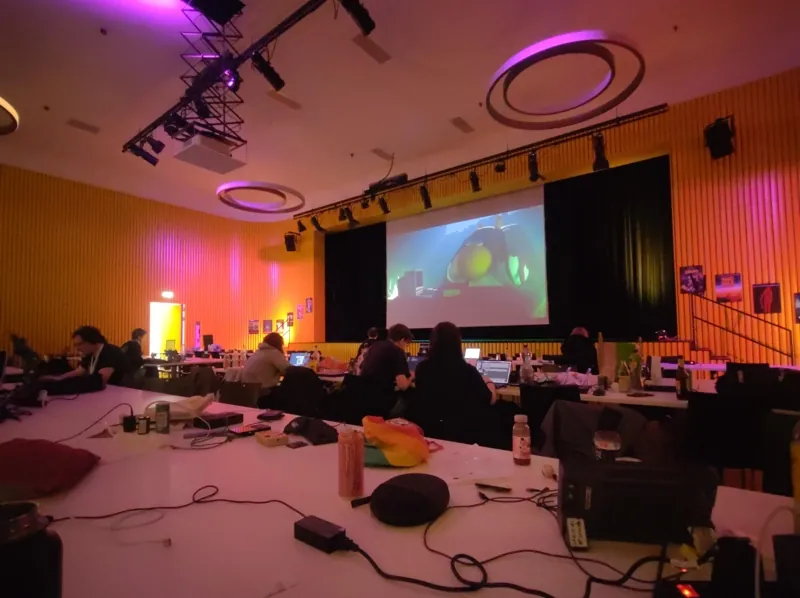
Striking yellow walls that look kinda purple in this lighting! Photo by jicka
before Mountainbytes
The trip to Mountainbytes happened at a pretty psychologically weird time for me/us; I won’t go into it but it came shortly after writing how many of us are in here, and the experience of the trip fed into writing disaggregation. The demoparty came on the back of a very busy week first visiting jackie and some friends who were also visiting Northern Ireland, and then hopped over to London to play in an erhu performance at the Goldsmiths University Lunar New Year Gala. Each context inhabited by a slightly different species of canmom.
The former is mostly private, though I will give a nod to the lovely Donaghadee lifeboat museum.
The latter was a really incredible celebration of Chinese dance and music traditions, put together by the Confucius Institute. After getting in a rather strange state of mind sitting in the unfamiliar university, walking past art exhibits of ISIS prisons and sitting in an empty classroom reading Persona under a very self-referential painting… I was able to start rehearsing with my teacher Wen Li and four other students for our performance of Horse Racing. An intense day of rehearsals got us all playing in time and we hammered out the final details of the performance.
I reckon we did a creditable job of playing the song (the rest of us largely in support of Wen’s expert performance, but it worked) and as an experience, it was amazing. I got to poke my head in to much of the rest of the show as well and oh my fucking god, Chinese dance traditions are the coolest shit?? It was fascinating seeing such a variety of both traditional and modern approaches drawing on many different parts of China, and of course a lot of Chinese dance involves these gorgeous flowing costumes which are just incredible in motion.
Naturally most of the audience consisted of parents of the students and other people associated with the Confucius institute, who lingered after the performance to enjoy a nice big Chinese buffet. Behind our performances was a video projection, for us mostly imagery of horses. I’m not entirely sure who made this, but I feel like there would be a ton of potential for integrating dance and realtime graphics if we could just get the right people to talk to each other about it.
the party itself
The next hop took the canmom body-interface-platform to Zurich, then to Steinhausen by train. I had a bit of a rough time because for whatever reason, my mobile data refused to work for a couple of hours, making navigating the train system rather difficult. But I made it there in the end, found something to eat at the nearby supermarket, and settled in. The workshop students were by that point already getting going on their projects, but I was able to float around and see if anyone wanted to learn about shader programming; fortunately, some people did, so I wasn’t entirely extraneous.
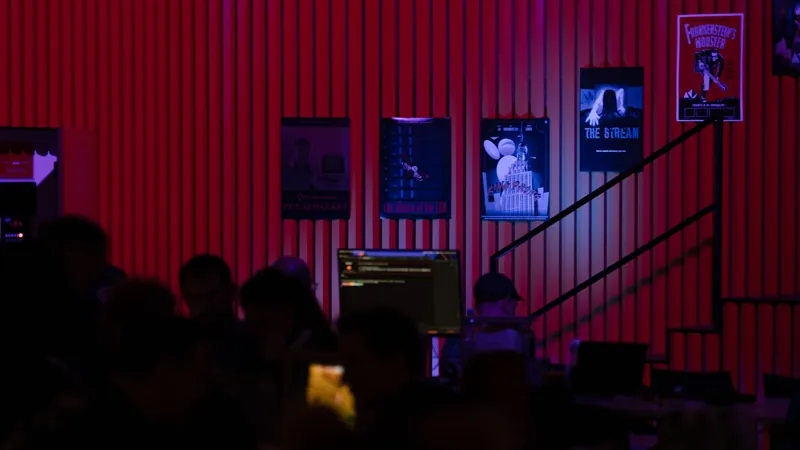
A few posters glimpsed on the wall. Photo by Maya, CC-BY-SA.
Mountainbytes is a small but very very friendly party. Within the larger demoscene ecosystem, in some ways it functions as a kind of overture to Revision, since both the Meteoriks shortlists and the Revision invite demo are traditionally released there and it shares many of the same orgas. We’ll talk about that shortly. But focusing on the party itself, this year they had a delightful horror/b-movie (b-moovie? sorry :p ) theme, with all sorts of posters sporting suitably awful computer graphics puns decorating the venue (submitted by a variety of sceners in the months before the party), and niche horror movie DVDs handed out in the prize bags. A fun little parallel to Deadline last year!
I was hoping to finish the prod which would eventually become Shaderland: Swizzle’s Journey at Mountainbytes, so I spent much of the first day of the party partycoding. At some point it became clear it was not happening so I decided to shelve it and release at Revision instead, which considering how much further work was involved, was a very good decision.
The party featured a music performance by Baumann Bergmann Pokinsson. Unfortunately, at that particular moment I was having a somewhat rough sensory time so I had to duck out of the hall—hopefully someone else can comment on this!
Other anecdotes: after a minor pizza mishap in the complicated order, I ended up needing to go out and find one of the very few late-open restaurants in Steinhausen. I am not sure what the host made of this strange lanky British woman, unable to speak more than a word or two of German, coming into her fancy restaurant to order a basic margherita pizza as the only non-meat item on the menu. Hopefully she thought well of me. Switzerland is one of the countries where the shops and restaurants shut very early, so it was a little strange to walk the completely deserted streets.
I slept at the party hall, which was perfectly comfy, with a nice big room to set up our beds. Slightly more awkward was the auto-locking glass door: after making my way to the toilet during the night, I found that the toilet was considered to be in an outer area and I could not return to my bed… luckily, someone happened to pass by before too long and let me back in, or it could have been a very awkward night.
The Meteoriks
I was part of the jury for this year’s Meteoriks awards. This is an annual award show taking place at Revision highlighting the best demos in various categories, each individually judged by a jury. So lemme talk a little about the experience of that.
I was reluctant to join the juries at first, because I can’t claim to have a huge amount of experience in the demoscene… but, after multiple calls to jurors went out, the inclination to join in won out over the reluctance, and they seemed happy enough to have me.
So, why? I was interested for a few reasons: it seemed like a place where discussions of the demoscene as an art subculture would happen. I wanted to see the process of this mysterious award show which I’d encountered last year, and I thought it would be a good motivation to actually sit down and watch all the hundreds of prods released over the last year.
I can’t say too much about the internal discussions because they are private by design. But it’s probably OK to say that I was on the juries for Best Visuals and Best Direction.
We could regard these as sibling categories because both of them are inherently cross-platform and also extremely subjective. That brings a set of conceptual challenges: how do you judge the ‘visuals’ of a Commodore 64 prod, with the limitations that entails, against a modern PC prod? How to compare an intro to a demo? How do you compare something which creates avant-garde, abstract visuals (i.e. a Wrighter intro) against something which aims for photorealistic rendering? How do you weigh a demo which has a lot of great shots but a few rough ones against a demo which doesn’t reach the same highs but is more consistent? What aspects of rendering fall under ‘technical achievement’ vs ‘visuals’, and how can we be sure the technical achievement jury agree on that front?
These are all questions on which people could very reasonably disagree. My own tastes, and my experience as a programmer, skew new-school, but I tried to be cognisant of platform and size limits. I was particularly interested in celebrating demos that broke new ground, using new techniques or doing things that hadn’t often been done in the scene before.
Still, I think I underestimated quite how much work being a juror would be! Although there were several stages of preselection to narrow the field, one of the categories still had a spreadsheet of hundreds of entries to filter through. (The other had a different procedure.) I tried to cover as much of the spreadsheet as I reasonably could, and give everything a fair shake; wherever possible (which is to say, for Windows and Linux demos) I made sure to run it on actual hardware. I did my best to ensure that every demo in consideration had at least two votes in the first stage of filtering, and the end I considered 262 prods (one of the other jurors managed to vote on 510, nearly all of them!). This led to a good few discoveries of quality demos I hadn’t seen, so it was worth the effort.
Award shows are always a bit of a dubious prospect. Had the historical dice fallen slightly differently, a different shortlist could have come out. (One demo actually got shortlisted after nearly being neglected for consideration, just because I’d reviewed it early before really calibrating my personal scale and given it a ‘Maybe’ which I later updated to ‘Yay’.) So if you disagree with any of our Meteoriks picks… yeah, fair enough! While it’s unlikely anyone would be able to spin up an awards show as high-profile as the Meteoriks, I would love to see personal celebrations of their favourite demos of the last year. Maybe I’ll write one.
Mountainbytes prods
I won’t be reviewing every prod released at the party, but I will discuss some that stood out!
I did not take a ton of pictures so here’s a random one of your girl walking through Steinhausen.
Graphics
The winner of the voting was, perhaps not surprisingly for anyone who’s been in the scene the last few years, a work of the immensely talented digital artist and web dev Steffest: the Matriarch. Steffest created a gorgeous portrait of an old woman in an Amiga palette, using his own custom drawing software dpaint to colour it. There’s a timelapse of it too:
Stef is one of those sceners who came to the demoscene with, evidently, a ton of art experience; all his pieces have the really strong eye for composition, form, and value structure that you only get by many, many hours of diligent studies, and indeed you can see an archive of his works going back to the 90s here, in both traditional media and digital pixel art. Like many of Stef’s pieces, this seems to be a hybrid piece, first working in the values in a digital painting program and then bringing it to dpaint for a final colour pass.
One thing I really appreciate about Stef’s recent works is his interest in depicting older people. He’s got a great eye for creating interesting faces, and especially in these pieces, he brings so much depth to the characters’ expressions as their gaze is lost in the distance (or magical orb), creating a space to fill with your interpretation of what they may be feeling. Wrinkles and sepia palettes seem to be a great fit for the Amiga… but also of course on a thematic level, age and death seem to be kind of looming a lot on the demoscene at the moment, which is negotiating being a very nostalgia-oriented computer subculture that hasn’t really quite resolved what it is going to become for the new generation for whom Amiga boingballs are a bit mystifying. This is going to be something to talk about a lot more when we get to discuss Razor1911’s eponymous demo in the Revision writeup.
Vivid rendering of faces also formed part of hemostick’s entry The Offering, which was in many ways quite specific to Mountainbytes: not only playing on the party’s great love of cows (expressed among other ways in their Cowee mascot character), it also explicitly draws on the work of a Swiss artist, perhaps the most famous Swiss artist: HR Giger. So we get a looming, sinister cosmic cow in a highly Giger-like rendering style, composed with a striking horizontal symmetry. Unlike Giger’s, work it does not have the same preponderence of phallic mechanical imagery which proved so influential (dare I say ‘seminal’? ;p ) on future artists such as Tsutomu Nihei, but we can’t have everything.
Unlike demos and tracker music, which are forms of art incubated largely within the scene itself, digital art is not something that is celebrated but not really cultivated in the demoscene; if you want to learn to draw, on computer or otherwise, you probably need to go elsewhere. So artists in the demoscene tend to bring their influences with them. This can be seen vividly with the instantly recognisable works of Suule, who this year brought a hurt/comfort furry image of a battered cyborg in a classic 90s dithered rendering style. I really like Suule’s work; something about the way it constructs space it brings to mind 2000s indie games like Iji.
I keep meaning to enter graphics compos and not doing so. Maybe I’ll get something in later this year…
Demolab (beginner demoscener workshop)
We had a packed Demolab this year, with an enormous variety of entries on all kinds of platforms: 256 byte DOS demos, web demos in Processing, even an oscilloscope music track! Since I was a mentor here, this is the category I will be talking about everything. Like last year, the participants were provided with a bunch of songs by sceners to use in their prods, allowing them to focus on visuals. The mentors would go around checking in and providing advice or support, and at a couple of points we gathered for discussion, but for the most part we let them all get on with it.
The prod I helped the most with was sin circles by mahal. mahal travelled an enormous distance to get to the party, and I ended up sitting down for a lesson in the basics of Shadertoy and 2D distance fields—a hard road, but one which allows some of the most flexible and powerful effects. mahal took the basic ideas and iterated them into a cool revolving chain of boxes. It was really cool getting to see someone experiment and iterate on the tools. Everything flows from this.
I was particularly impressed to see someone produce an oscilloscope music track. I have mentioned on various occasions that I think oscilloscope music is incredibly cool; I continue to think oscilloscope music is incredibly cool. I’m not sure exactly which software bluetonyum used. It may have been Osci-Render or perhaps OsciStudio. In any case, for such limited time, they put together an impressive range of effects on top of the base drawing.
Jena had an entry that, like much of her work, reflects her fannish devotion to the history of the demoscene—in this case, a photo of some custom plushies she made. It’s kind of a high-context piece; one of the plushies represents one of her friends, minecraft youtuber MaximumG9, another a classic demo effect known as a glenz vector which consists of a spherical-ish cluster of transparent triangles. Jena is one of the youngest people I know in the scene, drawn by an intense special interest in its history, and despite some fairly fraught interactions with older sceners it makes me really happy to see her continuing to produce quite personal works. I’m looking forward to seeing her technical skills and expressions evolve.
Growth by Razielle is one I saw develop over the course of the workshop. Using the browser rendering framework p5.js, it shows leaves made of ellipse segments growing on an archimedean spiral stem. I really respect Razielle’s dedication to figuring out her own effects with these tools, and combining the individual elements she learned into more complex effects! (Note that if you download this, you should serve it over HTTP using e.g. python -m http.server 8080, otherwise CORS requests may fail to load local assets such as music.) Mandaloopsie by das-g, with help from Razielle, was the other to use p5.js, and das-g made the ambitious choice to create a different variation of its core effect for three different songs. The effect in question, as the name suggests, draws on mandalas, in this case interpreted through slightly inclined ellipses in various colours, first spinning and then growing into a chaotic ball. The effect can be quite hypnotic.
Bitgoat interpreted the event as a game jam and accordingly made a little flight sim in Godot, with some procedural geometry. Another Godot prod came from huge NixOS fan MartiniMoe, who demonstrated the most foundational of demoscene arts: making cubes rotate.
gäss did something very cool, and implemented the munching square algorithm as a set of tiny Linux intros. Sadly, on my distro/terminal, I can’t seem to get the output to display, but huge props to gäss for doing things the hard way and going straight for coding in assembly, all the more so for targeting Linux.
Bitflex0r made a cute little pixel animation using Pygame, which has the nice advantage of being cross-platform =)
binary-sequence, one of my fellow workshop mentors, made a little Commodore 64 intro which displays the letter H. I believe this was his first time using the platform, pretty cool to figure that out while also teaching everyone lol. Meanwhile, dominikr and mikerofone released a C64 scroller inviting everyone to a small Swiss C64 party called Die Diskette.
It was really good to be able to stand in the hall and watch such a diverse set of first prods come up. My memory is hazy at this moment of writing, but I recall going up on the stage to give some brief comments on it. I hope I’ll be able to participate again in Demolab next year, perhaps try to provide some more structured support to people interested in learning my corner of graphics programming—admittedly, quite a hard thing to really teach in a weekend, since it’s heavy on both maths and boilerplate.
OHP
The Overhead Projector competition is one of the unique traditions of Mountainbytes. This year we only had two entries and I was a little distracted at the time the compo happened; unfortunately, recordings are not available so I can’t comment in a lot of detail on the individual prods (I have vague memories of cows), but I continue to find this very endearing. I hope I’ll actually be able to do one next year.
Oldschool and Alternative
This is the catchall category for ‘not a PC’, and we had quite a variety here. ceemos even released a demo for a tiny LED-array conference badge. I have not been able to track down the source although it is reportedly available, but I admire the spirit of turning every conceivable computer into a demo platform.
The overall winner was a scroller, but the scrollingness can be forgiven because the effect is a really gorgeous pixel drawing of Boris Karloff in costume as Frankenstein’s monster in the 1931 film. Extremely on-theme for the party, and rather than simply scrolling, there was a pretty cool progression with the monster’s hands coming up and lunging to hurl the text into the air, giving it some visual interest. If all scrollers had this much going on I’d probably like the genre a whole lot more…
Spreadpoint’s Amiga demo +=+ should definitely also get some recognition. With a strong visual identity defined by structures of blue lines being drawn by white dots, it builds up steady hypnotic patterns, all nicely integrated with the music: the synth surges as a line passes near the screen. Over time, rectangular patterns give way to more complex orbiting pentagons and octahedra, and then to recognisable wireframe representations of the robot helmets of Daft Punk, as well as a model of two touching hands.
Sadly, a flaw with this one is that halfway through the eight minute runtime, the effects start to repeat—this combined with the overall slow pace makes it feel like it is on the long side, and would have been better served to hit a definite ending. But the minimalist approach is very strong! I’m excited to see the next prod Spreadpoint do.
PC Demo
The PC Demo compo was, as has been the case since Revision started releasing their invites at Mountainbytes in 2024, won by the Revision intro—but honestly deservedly so, I’ll have to give that one a section of its own since there is so much to say about it. First, though, other PC prods: we had some compofillers (including a farjan by the group Siegerländerfinnlandliebhabergruppierung which I mention largely so that I can put the name of the group Siegerländerfinnlandliebhabergruppierung). Ernie had a nice little Cables thing with some particles.
There were a couple of 256byte prods for Linux. Orange vs Green by dominkr helpfully included clear instructions on how to actually run a 256byte Linux prod, although unfortunately didn’t seem to work quite right on an ultrawide aspect ratio. Still, it’s cool to know that this is even possible on Linux! And Kandid’s Say Hi was very sweet.
BHACK by Japotek and Spinning Kids appeared to be showing off some raytracing effects, including reflections and refractions, in an OpenGL renderer using various test models including the Nefertiti bust and a chess set. Running it again at home at 3440x1440, some impact was lost to framerate drops, but helpfully the creators included the shader code along with the actual executable, so we can take a look inside…
Turns out it’s actually doing something pretty interesting: it’s tracing rays in the fragment shader using a custom BVH data structure that is passed in as a texture, two pixels per BVH node. I assume the BVH construction happens on the CPU; it’s not present in the shader. Really interesting concept, and a very oldschool (read: before compute shaders) way of doing things! It just needs a little optimisation and some more presentation polish—it seems like all the effort has gone into the raytracing code, and having some more conscious direction and original models would bring a lot to it.
The most substantial demo not to be the Revision invite was Δ (that’s the Greek letter Delta), a 4K by Team210 and Epoque. Sadly this is the only one in the set not to work under Wine, so dust off your Windows partition ;p
As the demo begins, the camera steadily rises up a column of white, intersecting cubes, pulsing and spinning in time to the music. As it goes on, more complex effects layer up, including VHS-like distortions and subtle chromatic aberration. Coloured stripes appear in colours resembling the pan pride flag and then, abruptly, the cubes become smooth and you realise that they were an implicit surface all along.
Short and sweet, clear art direction and well-choreographed: it’s a very solid 4k! I was even thinking I might vote for it over the Revision invite, just for the sake of favouring something other than ‘Revision wins every year’, but then…
the Revision invite
Revision is the largest pure demoparty and so its invites tend to be a pretty major event. This year, they brought together a group of largely UK-based sceners, which means that I am friends with pretty much everyone in the credits lol.
The demo is an outright short film. It is by far the most elaborate Revision invite I’ve seen (and I’ll be excited to see next year’s answer). It centres on the character Evilbot from two prior invites, who became something of a demoscene meme.
Let’s quickly run down those credits! In the director’s chair was fellow Scottish scener Mrs Beanbag, and her partner Aldroid is credited as the ‘associate producer’. Halcy is further credited as ‘assistant director’. My friends Vurpo and RaccoonViolet worked together on the character designs and 3D models, with Ando credited for 2D graphics (character faces and the Slipstream logo). Jeenio coordinated musicians jco and Gasman to cover the multiple tracks in the demo, and Enfys covered further sound effects while Bus Error and Ziphoid voiced the characters. I’m told most of the code was written by Halcy, Aldroid and Mrs Beanbag; Gasman is also credited for ‘additional code’. The full repo is available on Codeberg, with the commit history squashed.
Evilbot’s story began back with 2013’s This Is Revision, which featured a round blue-eyed robot singing a saccharine song about the party only to be interrupted by the sarcastic, dismissive interjections of a black-and red robot with a triangular jaw speaking in a harsh monotone speech synth. The robot was soon named ‘Evilbot’, its counterpart ‘Goodbot’. By the end of the intro, Evilbot takes over entirely to an aggressive dubstep soundtrack.
2016’s The Return, by a different crew, added a kind of origin story for Evilbot: an aspiring demoscener, Evilbot was disqualified by a party software bug and thus went on a campaign to cause mischief at the party, such as making the toilet tunnel even longer. Most notably, The Return was related mostly in rhyme, and towards the end it featured Evilbot singing a duet song.
The Golden Disk picks up the story: Evilbot is now cast as not just a pantomime mischief-maker, but an avatar of the evils of tech at large—particularly, cloud computing. (In this, it follows the contours of a recent trend of self-reflective demos such as Fairlight’s 13:37, which place the somewhat impenetrable creative ethos of the scene in opposition to big tech and AI.) TGD sets itself up as a pastiche of Saturday-morning American cartoons, most specifically The Transformers (1984-7), and naturally it has to lovingly one-up The Return with a genuine banger of an 80s-style theme song for the d-d-demoscene by Gasman. (Indeed, songs with lyrics would prove to be a real theme at Revision, but we’ll get into that in the next article!)
Using a custom OpenGL renderer which can also be compiled to a WASM+WebGL target, the demo is largely rendered with cel-shading; for the most part, it is lit by a single directional light with sharp shadows and a lot of flat grey surfaces that almost give it a Sketchup kind of vibe. The result has a clear stylistic coherence, though I found myself wishing for some slightly stronger colour picks.
Although the character designs are incredibly charming (I love Evilbot’s samurai-style armour), the character animation is—perhaps appropriate to its inspirations!—quite limited, and perhaps the main flaw of the demo; there is little sense of weight, particularly in walk cycles, and in many cases the animation is quite stiff. But these minor flaws do not matter at all really, because the concept is just so lovely and the overall direction is immensely strong: there’s a huge variety of delightfully constructed scenes and the story arc perfectly nails the tone of its inspiration, as well as providing a pretty overt theme of personal transformation (fittingly for a prod with as many trans people working on it as this one), as Evilbot reforms his evil ways and transforms into a VW van after a suitable lecture from Optimus Prime the E-Werk.
Fleshing out this story are cute little scenes that make it clear just how much fun the crew were having with it: the Amiga’s cat ears, the evil Clouds turning into herds of good Clippies, the Spectrum’s buzzing synth voice as it catches the Golden Disk, Evilbot falling into the Bonzomatic default shader tunnel, 13:37 on the clock, the tiny Kevin plushie. And in van form, Evilbot is driven by Goodbot from the original This Is Revision, and a brief musical reprise of Goodbot’s song even comes in as Evilbot remembers and frees Goodbot.
So, yeah, The Golden Disk charmed my socks off, and I had to vote for it after all. I was very impressed that Mrs. Beanbag and Aldroid were able to keep it under wraps for the whole of Mountainbytes. I remember tracking them down to give some very effusive congratulations.
I recall someone remarking that this belongs in a notional ‘British style’ of demos which don’t take themselves too seriously; my demolore isn’t really good enough to furnish what other demos might belong to this style but I can believe it. Alas, the precise details of the conversation have escaped as I write these words… I feel like I need to study the ‘art history’ of demos more strongly to be able to comment better on this kind of thing.
This is not as I initially thought Mrs Beanbag’s first time directing a demo… but regardless she rules, I can’t wait to see what she does next. The fact this appears to have been coordinated very consciously as a film, with a director, storyboards etc., is interesting—while I certainly enjoy the abstraction and technical wizardry of most demos plenty, I was drawn to the demoscene from my broader interest in animation, so when I see demos adopting the formal elements of other types of animation (not necessarily just narrative film), I find it quite exciting.
the wanky philosophical bit
Of course, overall, The Golden Disk must function as a party invite, so its story must revolve around the demoparty, amusing regulars and intriguing outsiders; and it is also mostly a pastiche of an older style of animation. But, consider how Gainax emerged out of creating the pop-culture stew of the Daicon III and IV intros. I do not know where we will go from here. Many things are possible.
I wrote last year about how the Line Rider subculture matured over time, formally and thematically, and indeed I recently had the chance to interview Bevibel and September on that subject. While ‘story demos’ are nothing new, I am fascinated by the idea of similar shifts happening within this subculture. So I am continually intrigued by the times that demos explore moods and types of storytelling that they had not before (for example, Conspiracy’s atmosphere-drenched Darkness Lay Your Eyes Upon Me, now ten years old!). But there will be a great deal more to say about that when we come to write about Revision, and Razor1911!
‘Why are we doing any of this’ is a question that will eternally be asked for as long as there is such a thing as a demoscene. A moving target, too, for the thing we call ‘the demoscene’ is a composite thing; over time, its shape changes as people come and go and change. If, in 32 or 64 or 128 years, people still identify what they’re doing as a ‘demoscene’, it might not resemble today’s spread of activity at all… and what exactly will be preserved is difficult to say.
Demos are simultaneously a type of short film or music video to be viewed in the language of those media, a technical demonstration of computing judged on arcane criteria, a personal expression to a specific subculture… well, the same is perhaps true of all art. Why am I drawn to pursue realtime graphics, when results could likely be achieved faster in Blender, without having to reinvent quite so many wheels? Because on some level I want to understand… the final film is part of the expression, but so too are the processes which gives rise to it, both in the moment of running the software, and the longer process of conception and development that blends indistinguishably with living.
For a bunch of people, the demoscene is a refuge: the party hall, closed off and glittering with computers, is a place where for a brief window the rules can be different. Here, you might find people who actually understand the strange contexts that inhabit your head and remain so opaque to everyone else, the particular(ly autistic) ways of being we occupy, these thought-things which bloom so unpredictably in the wider population. I inhabit a bunch of different contexts, and many of them would be equally alien to most sceners, but this computer graphics thing is evidently quite mysterious to most of my friends back here. It is hard to speak of this because online the demoscene is so abrasive; I would never have imagined it would be so welcoming in-person.
Humans are creatures which build structures in our heads. No matter what the field of engagement with the world, it is rich in jargon, esoteric knowledge, criteria to optimise against, histories to know, etc. etc.; and then we absorb all of that, build mental representations, and eagerly look for another layer to add. This is our “magic”; this is the significance. Understand something is the intimacy of representing its structure inside yourself.
Next up: let’s talk about the project I’ve been working on for the last year, Shaderland.
Comments