So, that was a hell of an episode. We’re at the Tea Party now so there remain just two more chapters, unless this one does something funky with the format.
The Tea Party opens, unlike the others, still during the game. We see a date: ‘The Second Day, Oct 5 1986’. Then, a clock winds nearly twice round, until it’s 10 minutes to midnight.
We open with a first-person narrator—no doubt piece!Battler—expressing confusion. Apparently, after his ‘test’ with Beatrice, very little has happened. But he has somehow managed to enter the mansion and is now eating from the fridge.
He grumbles about how ‘annoying’ Beatrice’s lack of answer was, and in a flashback, we learn that she told him to go to the chapel. (Wild for Battler to be bored and annoyed rather than shit scared under these circumstances, but it is an odd game.) There, there is a bundle of keys: the master keys to the mansion, though not to the chapel itself. So that explains how he got in, at least.
Indeed, Battler seems bafflingly blasé about the pervasive smell of dead people in the mansion. But this does mean we get the opportunity to see some death screens as he confirms the state of the bodies. Deep breath… unfortunately the death screen text does not appear to be available in the same place as the script files so I gotta copy these out manually!
This is gonna be a huge infodump plot summary, but lets get all the death info in one place:
All the deaths
First, let’s list what we got already about George:
- George
-
Corpse discovered by the rose garden arbor. There was a single hole right in the centre of the forehead. It seems reasonable to think that he was shot with a gun or something.
It was a brand of humiliation, marking his loss to Gaap.
So, the first six all get the following, modulo pronouns:
- Rosa, Eva, Hideyoshi, Rudolf, Rosa and Genji
-
Corpse discovered in the dining hall. Her head was half destroyed. It seems reasonable to think she was murdered with something like a powerful gun.
However, the witnesses don’t believe that she was killed with a gun…
Along with those six corpses, Battler finds the corpse of Maria:
- Maria
-
Corpse discovered in the dining hall. Unable to locate any notable external wounds, Battler speculated that it may have been some type of poisoning.
The most peaceful method of inviting a person to the Golden Land.
Even though she passed Kinzo’s test, she died.
Battler’s flat affect is addressed: off-camera he ran around the mansion yelling and crying earlier, but nobody showed. So after a while he tried to figure out what happened.
He found foam around Maria’s mouth, like a stereotypical TV poisoning. Seems like we’re going to get some murders to solve after all!
Battler searches for the “pitfalls” (「落とし穴」) that were mentioned on the phone by Krauss’s group and Gohda. He can’t immediately find any evidence of a pitfall mechanism under the carpet, and he believes there must be five separate pitfalls to get them. He speculates briefly about some crazy elaborate mechanism that Kinzo might have built.
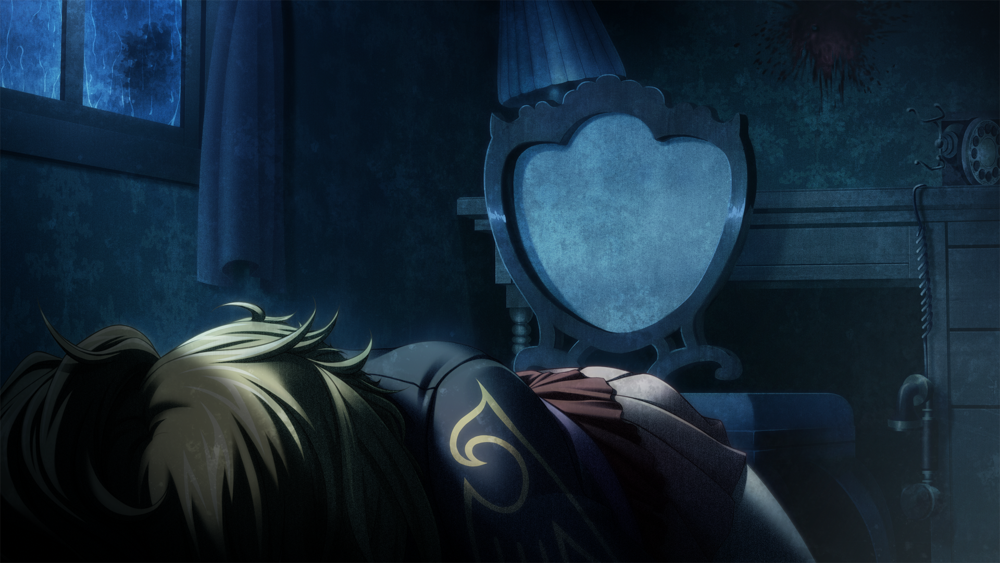
Don’t worry, she’s just eepy.
As for Jessica, we’re getting the expected locked-room puzzle. Jessica’s body gets a CG. As usual, we get Battler’s speculations followed by Beatrice’s comment.
- Jessica
-
Corpse discovered in her own room on the second floor of the mansion. Her head was half destroyed. It seems reasonable to think that she was murdered with something like a powerful gun.
Destroyed herself with her own strike with George’s counterattacking-type barrier.
Helpfully summarising for us the odd things that he observed ‘in character’, he notes…
- Jessica knew that she was going to die with ‘half my head spilled out’ when she phoned him.
- her head might have been destroyed separately from a fatal head wound she received before the phone call, and the former might have obscured the latter.
- she seemd to know that George had been given an ‘instant death’, but she couldn’t see more than the roof of the gazebo from her room.
Kyrie’s description is next:
- Kyrie
-
Corpse discovered in a guest room inside the mansion.
There was a single hole right in the center of her forehead. It seems reasonable to think that she was shot with a gun or something.
A demon stake was rammed into her forehead, but it is difficult to imagine that this was the cause of death.
I didn’t miss. I missed on purpose to torment her nyeh…!
Battler pulls out the stake, and makes the connection to the epitaph. He finds it hard to believe it could have been jammed in there by a person, though. He speculates that she was also shot with a gun, but recalls Kyrie’s quote about the ‘golden thread-like thing’ attacking her through a keyhole, noting four points of damage around Kyrie.
We get some details on the lock. “The familiar, average cylinder style that you could find in any normal house.” with no through-hole for an attack to go through. Even more mysterious! I wonder if there is another “keyhole” in the room?
Battler considers the many eyewitness reports of magic. He considers that they may be ‘losing their heads a little’, but finds the consistency of the reports too much.
Krauss is next:
- Krauss
-
Corpse discovered in the vicinity of the mansion’s back entrance. His head was half destroyed. It seems reasonable to think that he was murdered with something like a powerful gun.
A demon stake was rammed into the destroyed portion of his head.
None can escape the Chiesters’ golden arrows.
The manner of death is very consistent this time around. Which means if we can think of just one murder weapon that would do all this—Battler imagines an ‘endoscope-like’ weapon—we could explain it all. But if no such weapon exists, he says, he’d have to accept it was magic.
Noooo Battler! C’mon man! Don’t give such an easy fork to Beatrice!
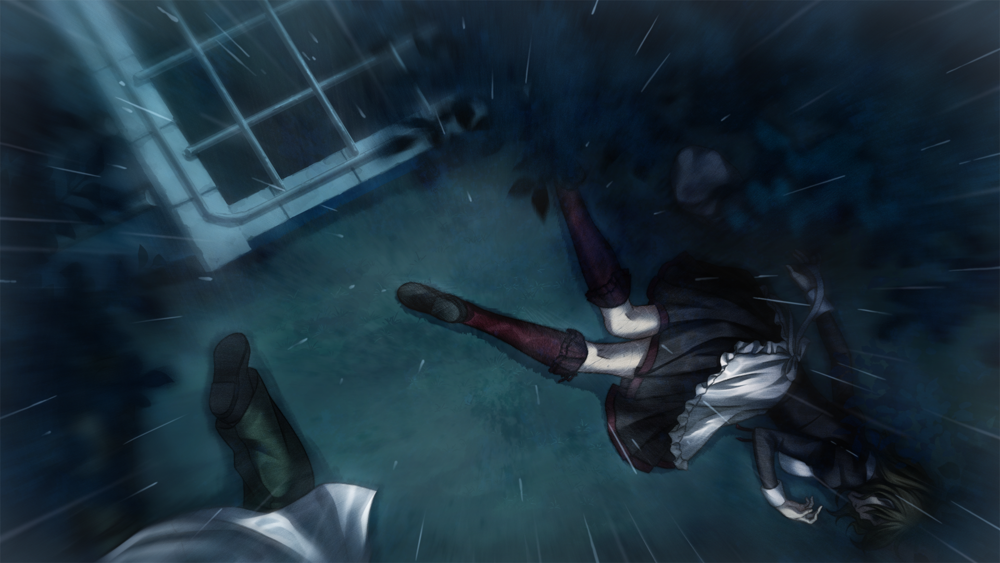
They’re just eepy too. It’s really comfy there by the well.
Battler finds the old well, where Sayo and Nanjo are found—this, too, gets a CG. Death reports:
- Sayo
-
Corpse discovered behind the mansion. Her head was half destroyed. It seems reasonable to think that she was shot with a gun or something.
A demon stake was lying next to the corpse.
The witnesses understand one thing at least: it was not the stake that killed her.
If this is supposed to be the ritual, it’s pretty half-assed. ‘Gouge the head and kill.’ over and over.
Battler speculates that Beatrice and her accomplices must have retreated to Kuwadorian down the well passage. He decides to follow them. However, he discovers an iron grill over the well, which he speculates to be controlled by some hidden mechanism. Needing a tool to break in, he goes to the gardening shed, which is maybe our only actual locked room mystery.
He goes to the boiler room where there is a terrible stench. Flashbacks to episode 1! Are we gonna find Kinzo down here again..? Funnily enough, yes! In a reprise of the first episode, he’s in the furnace…
- Kinzo
-
Discovered as a burnt corpse from the incinerator in the underground boiler room.
As there were no signs that he fought to get out of the incinerator, it seems reasonable to think he was burned after he was murdered.
Dust to dust. Ashes to ashes. The dead to the dead.
Battler is careful to note that it’s not necessarily Kinzo whose corpse it is, but it does have Kinzo’s infamous six toes.
Now Battler gets to look up close, we do finally get Gohda and Kumasawa’s death screens.
- Gohda
-
Corpse discovered in the rose garden storehouse.
It is hypothesisezed that he was shot in the forehead and then strung up by his neck.
They themselves put their necks in the nooses. It was an interesting experience to try on occasion.
- Kumasawa
-
(same up until last line)
As long as a locked room could be constructed, anything would have sufficed.
Battler notes that the ropes are too long for a hanging, carefully adjusted to the height of the victims so their feet drag on the floor… and both were shot in the head first. He concludes the perpetrator’s intent must have been to make the corpses obvious from the window.
Gohda still has his key, and the shutter is locked, so this is a real locked-room puzzle. He notes this is easily solved by supposing there was another copy of the key after all… (though I imagine Beatrice will kill this with red almost immediately!)
That just leaves Kanon. Kyrie said Kanon was killed inside the well.
Battler finds himself unable to break the bars. He recalls the story he was told about Kanon cutting metal bars underground, and mentions it sounds like a robot anime he enjoyed as a kid. (Battler Gundam fan confirmed? The timeline checks out…) and briefly contemplates whether Kanon might be the culprit…
This prompts Beatrice to interject:
Kanon is dead. Among the five in Kyrie’s group, he was the first to die. In short, he was the ninth victim.
This does not reach piece!Battler (explicitly named as ‘the piece you’ by Beatrice, so I guess that name is pretty much canon), suggesting the epistemic state of piece!Battler and player!Battler is not synced. She says “it did reach you, right?”—the obvious candidate to be addressing here is player!Battler, and yet..?
Battler briefly contemplates the other mysteries he’s been told about on the phone:
- goat monsters
- witch who could create pitfalls just by snapping her fingers
- rabbit-like demons who had fired golden threads
So these concepts are not entirely in the world of Beatrice’s fancy vfx shows, but crossed over into Battler’s subjective observations.
None of Battler’s wonderings take him into Kinzo’s study, curiously. But it seems reasonable to assume he searched the house thoroughly.
Onwards
Having helpfully observed all the bodies for our mystery-solving pleasure, the listless Battler shouts for the perpetrator to come and kill him so he can see her true form. Midnight comes, and he finds himself before the portrait of Beatrice.
And the lady herself appears… amusingly, Battler’s first words to her are not about the mass murder of his entire family but his boredom at sitting around all day.
It seems like there is a real change in the affect of Piece!Battler. Where, previously, he became a horrified mess whenever the murders happen, now he’s coolly going around playing detective. Perhaps this is what player!Battler means when he says he’ll stop playing around—the relation between the two is still not entirely clear.
Ah, wait, we’ve shift into the layer of reality indicated by the floral overlay. So this is player!Battler saying he’s bored. OK, that makes more sense, he’s had plenty of time to get used to the sadistic events of these games.
Beatrice insists that Ange’s death was necessary to give Battler his resolve. It seems that, if she can’t withdraw from the game, now she just wants Battler to end it for her.
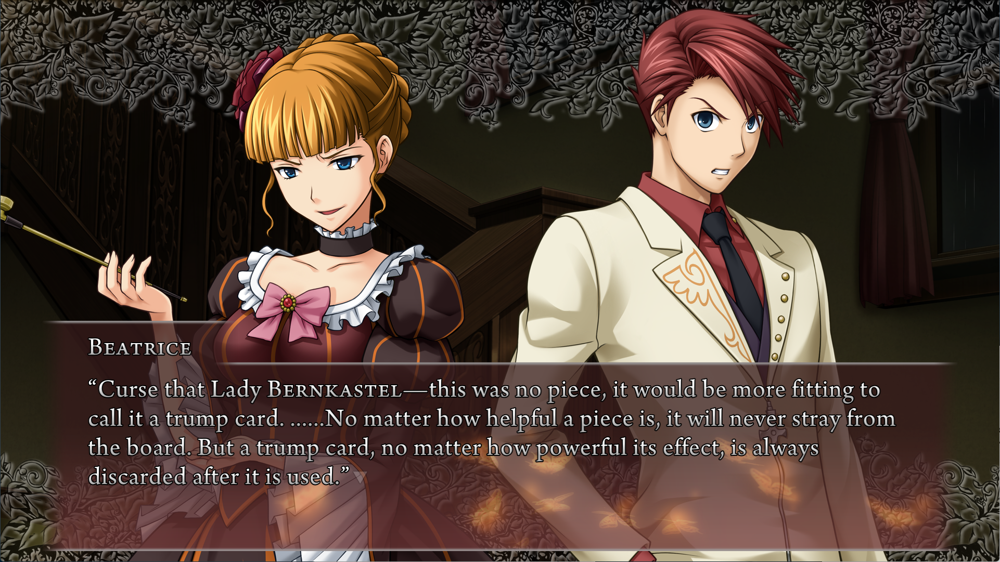
Now we’re playing a trick-taking game…
After a little more trash talk, Battler gives Beatrice the words she wants: “I will kill you”, which also merits a big red screen like we got at the end of the last episode.
So the game’s back on. To my mind, the biggest puzzles Battler has to explain are the ‘golden thread’ head-splattering weapon and the locked-room murders. We already have pretty good suggestions for most of these… it’s just the weapon that remains mysterious. Of course, we can always take the ‘Kyrie was mistaken’ or ‘Kyrie was a perpetrator’ theories to deny most of this testimony.
Battler’s attack
We enter a new version of the rose garden with a red-yellow filter applied to it. The narration goes on a brief tangent about flower language: while red means truth, roses signify passion. Truth, we are told, is represented by the forget-me-not, a blue flower. Some anime fans are hugely into flower language, and love to apply it to the shows of people like Ikuhara, but alas it is still mysterious to me.
Battler declares his intent is to solve the mysteries from all four games, not just this one! That’s exciting. So Battler gives us…
- Ushiromiya Kinzo is already dead!
- Therefore the true number of people on the island is 17!
- By adding an unknown person X to that, it becomes 18 people.
- By supposing that this person X exists, the crime is possible even if all 17 people have alibis.
- By this, even though the number of people reaches 18, it is still possible for culprit X to exist and carry out the crime even if all 18 people seem to have alibis.
Amusingly, ‘Episode 1’ is referred to explicitly in Battler’s first-person narration. He says this hypothesis solves all the murders. Kinzo’s murder is solved by assuming he was never even in the room where he was supposedly ‘killed’.
We can compare this with my theories for Episode 1. Reading back, I was burdened with trying to explain everything that was narrated, and not simply what was directly observed by Battler, so I was left trying to explain the ‘golden butterfly’ effect. It turns out ‘the narrator is unreliable’ was a card in the deck all along, but we had to figure out the constraints on that first!
Anyway, that said, most of my theories back then involved a single perpetrator. The locked rooms were not too extreme at this point and we have no red axioms to worry about. So my theory can skip over the part where Beatrice infiltrates the study, and otherwise proceed on similar lines.
Battler’s attacks here are illustrated with a 3D animation of a ‘wedge’ that has come down from the sky to pierce Beatrice.
Beatrice concedes this is a reasonable play, but says it’s insufficient for some of the later mysteries, such as the locked room deaths of George, Gohda and Sayo in the second game. At the time it seems that my theory was that either Genji or Sayo lost hold of their keys; later, that Rosa was an accomplice. Battler makes a similar play, suggesting that the murderer had an additional master key. Beatrice can answer this one:
Beatrice: All of the master keys were under Rosa’s control.
Battler answers this with the Rosa-accomplice theory. He puts it this way:
Battler: Aunt Rosa handed a key over to culprit X by some method, assisting in the locked-room murder! And after that, she retrieved the key by a similar method!
He notes that this was his theory at the time.
Since it seems that Battler is gaining ground on Beatrice and causing her pain, I feel like this can only be buildup to a classic Umineko turnabout where she suddenly drops a red truth at the end which invalidates all of Battler’s attacks.
Battler’s theory for Game 3 is the Eva culprit theory:
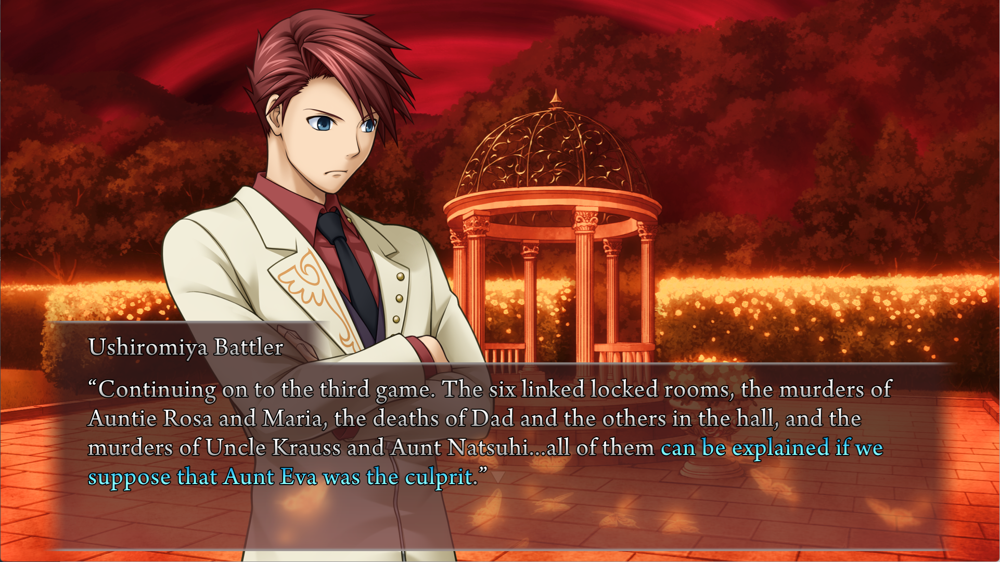
Battler: All of them can be explained if we suppose that Aunt Eva was the culprit.
And the Eva Beatrice ‘checkmate’ is solved by the 18th-person theory.
the murder of Doctor Nanjo, can be explained with an 18th unknown person X.
Beatrice counters by raising a new mystery, George’s unexpected disappearance from the guesthouse, supported by the following red move:
Beatrice: George did not go down the stairs of the guesthouse.
The narration notes further that all the windows were locked from the inside. However, Battler says he could have jumped out the window and it would not have left a mark on the grass in the typhoon. Beatrice counters that he could not have locked them from the outside:
Beatrice: All windows and doors leading to the outside were locked from the inside. Furthermore, it is impossible to lock any of those from the outside!
But Battler already has this counter:
Battler: In that case, everything works out as long as someone locked the window after George‐aniki escaped through it!
With these hypotheses, Battler declares he has solved the first three games and only the fourth could save Beatrice. Beatrice concedes this, since she has not given a red counter.
Here we go then… As usual, I will attempt to solve the mysteries before Battler. The mysteries as I see it are…
- the survivors of the dining hall massacre claimed to see ‘pitfalls’ opening, and various monstrous accomplices. They also claimed to directly meet Kinzo face to face.
- Jessica seemed to know how she was going to die when she phoned Battler
- Jessica was aware of how George died
- Kyrie claimed to be attacked through a keyhole with a weapon resembling a ‘golden thread’, but there was no through-hole
- Kyrie claimed that Kanon was able to manifest something like a lightsaber
- Kyrie claimed that Kanon died inside the well which she claimed connects to Kuwadorian, but the well is closed with iron bars
- Gohda and Kumasawa were killed inside a locked room and put on display in a way that would require entry to the room
Problem 1 is unclear. An easy but cheap play is to claim that the perpetrator drugged them with a hallucinogen. Maybe they even carted Kinzo’s corpse out. (They would have put him in the incinerator to hide the fact that he was already long dead.)
Problems 2 and 3 can most likely be solved by this theory: Jessica was witness to the death of George and knows that he was killed with a headshot; perhaps she saw the weapon used to kill the others. So she thought the same was likely to happen to her. George may have been killed elsewhere and moved to the gazebo after.
Problems 4-6 can be solved by supposing Kyrie is an accomplice and lying to Battler, although it’s not clear why she’d concoct such an outlandish story.
Problem 7 can be solved if another key or entrance exists, although Beatrice will likely rule this out. It could also be solved by the culprit using deception to convince Gohda and Kumasawa to open the door, then making a copy of the key before they leave and lock up the room.
I expect at least some of these hypotheses will be ruled out by the red. If I was playing ‘for real’ I would want to prepare some fallback ideas, but I don’t wanna get too bogged down with predictions!
OK, here’s Battler’s version…
- The 18th person X went wild with a gun and killed everyone
- Regarding the pitfalls, there is every chance that pitfalls truly were hidden there, and it’s also possible to explain them with Kyrie‐san’s theory hypothesizing the existence of a poison‐dart‐shooting device X which can knock a person out instantly
- The murders of George‐aniki, Jessica, and those who escaped from the dungeon can also be explained with guns, just like the dining hall
Beatrice counters with the eyewitnesses seeing Kinzo alive. She says:
All of those present at the family conference acknowledged the existence of Kinzo!
Assuming ‘existence’ here means ‘alive right now’ and it’s just a poor choice of words (I doubt anyone would deny that Kinzo exists in the abstract!), this could easily be explained by Krauss and Natsuhi arranging a deception, as discussed during the episode. However, this may be reading it overly literally, it seems like what she means is ‘acknowledged Kinzo was in the room with them’. (The Japanese word used is 存在, which can mean ‘presence’ as well as ‘existence’.)
Anyway, Battler focuses on not that literal phrasing but the dining-hall witnesses. He suggests that Kinzo, being seriously ill and rarely seen, would be easy to impersonate.
- That Grandfather was a different person, a body double.
- A different person who the relatives mistook for Grandfather!
“Body double” is 替え玉.
Beatrice answers:
No person would mistake Ushiromiya Kinzo by sight. No matter what the disguise, they would not mistake Ushiromiya Kinzo by sight!
The ‘by sight’ stipulation stands out to me. We don’t know that the witnesses saw Kinzo, though it seems likely that they did.
Battler makes an extended counterargument, directly addressing the whole question of ‘are the red claims consistent between games’…
- By declaring with the red truth in the second game that the number of master keys was five, when in the first game the number was more than five, you changed the premises of the later games.
- In the same way, there is a possibility that Kinzo’s life or death status was changed for the fourth game.
- Therefore, Kinzo’s existence in the fourth game does not serve as proof that he existed in the previous games…!
- Therefore, even if we suppose that the six murders in the dining hall were carried out by Grandfather himself, it doesn’t create any contradictions!
Beatrice quickly denies this one:
Kinzo’s life or death status is the same at the start of each of the four games. The setup was not different for the fourth game alone.
If we can elide context, the second sentence there seems like it could have broader application than just whether Kinzo is alive or dead…
Battler presses the question of whether Kinzo was in fact alive. If Beatrice did declare Kinzo alive for all four games, that would defeat Battler’s strategy in previous games, so she must have a reason for not doing this.
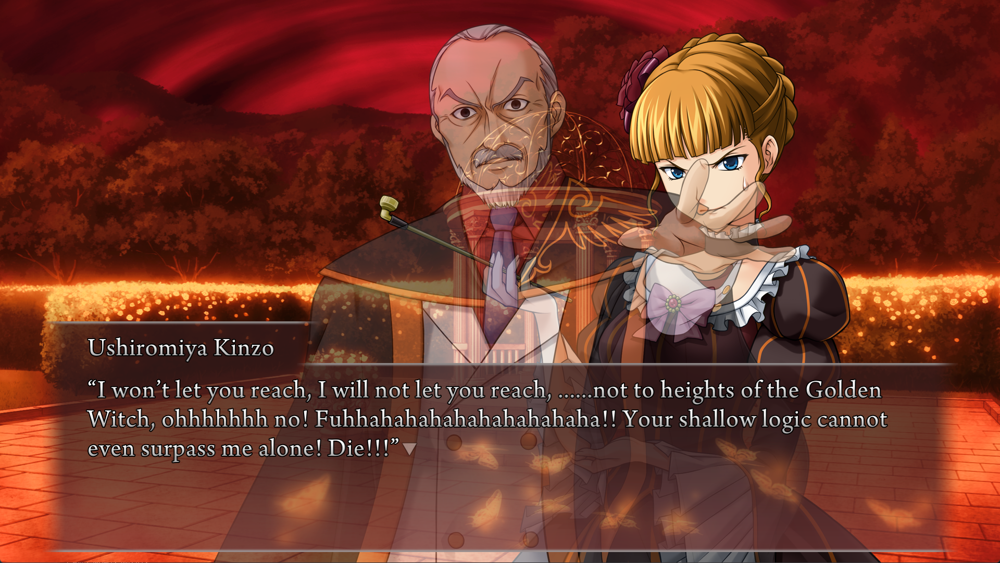
The ghost of Kinzo drops in. Mostly to laugh, of course.
There is a CG as a narrative flourish describes Kinzo turning into a dragon.
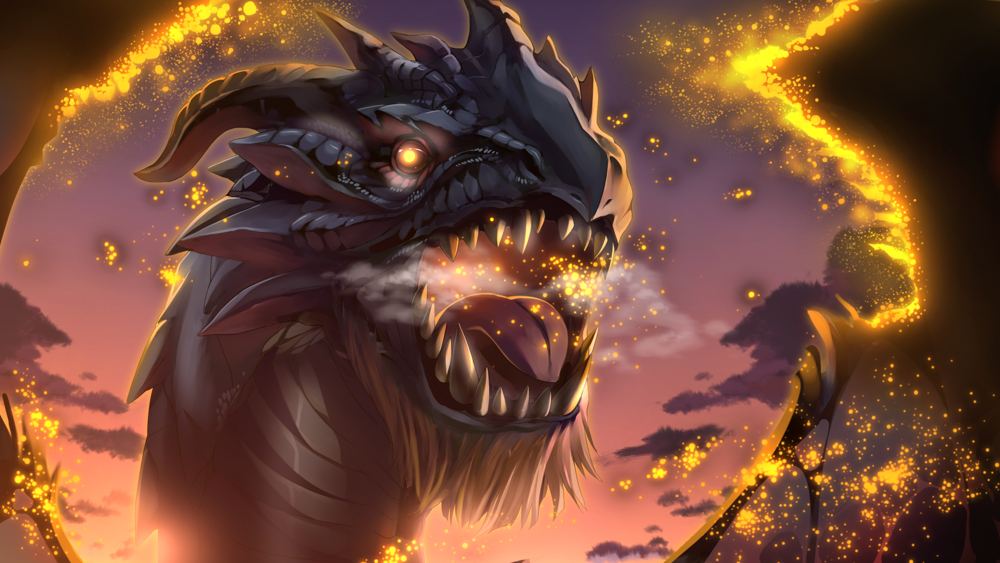
Did one of the artists just really want to draw a dragon? I respect that.
Battler is not deterred by a big dragon appearing. He comes up with the following fascinating theory, inspired by Beatrice’s own succession…
- My theory is that Kinzo’s name is passed on as the title of the Ushiromiya family head!
- Ushiromiya Kinzo was already dead.
- And he passed his name on to someone else!
- Everyone acknowledged it!!
- And, therefore, ‘all of those present at the family conference acknowledged the existence of Kinzo’!!
- There wasn’t even any need for this person to disguise themselves as Grandfather.
- Because everyone recognized a new ‘Kinzo’!
- Therefore, they didn’t actually ‘mistake Kinzo by sight’!!
- As long as the preceding theory is not disproven, nothing can change the fact that you’re dead!!!
I have to say, that’s a great theory. That’s the sort of wily linguistic bullshit that I would love to come up with.
Battler challenges Kinzo to repeat this claim: “Not one person present had multiple, differing names”, which he cannot. That’s… quite a broad statement to deny. Like Battler’s hypothesis could be wrong if someone else had multiple names. But that seems like a major clue.
(I have to admit I’m enjoying all the different translations of クソジジイ. “You old grandbastard” for example!)
He follows up… god if Battler is just going to say everything in blue I’m just going to end up copying out half the novel, but anyway.
- Ushiromiya Kinzo was already dead!
- Yeah, poor old you—whenever we find your corpse, it’s always completely burnt
- That was a gimmick to prevent discovery of the fact that time had passed since your death!!
- And you passed your name onto someone else!!
- With this theory, even though you are dead, “Kinzo” can still appear at the family conference!!!
- How’s that? This is checkmaaaaaaaaaaaate!!
I wouldn’t be so fast to call it, Battler. We know how that usually goes. The dragon CG evolves to show all these blue lances stabbing it.

Come to think of it, we are reading a novel by Dragon Knight 07.
So, time for a finisher. Perhaps. I’m waiting for Beatrice’s inevitable table turning to set up the Answer arc. But this sequence seems to be aimed at putting locked-room puzzles and the like to bed so the novel can shift gears to something else?
- George‐aniki and Jessica’s deaths in the fourth game can also be explained by culprit X!!
- And the five who escaped from the dungeon and were killed, and the two in the gardening shed, and Maria in the end!
- All of those can be explained with an 18th person X!!
- There’s nothing strange at all!!
Well, the locked room in the garden maybe, but yeah, OK sure. While Beatrice struggles with the rain of blue stakes, let’s see if we can predict the Beatrice counter. All of Battler’s theories revolve around Person X. So finding a way to deny Person X might do the trick. But if it was that easy, she’d have already done it. So it’s got to be something that introduces a new element—the ten of the kishōtenketsu structure.
But that could be all sorts of stuff.
Anyway, Beatrice focuses in on her ‘various displays of magic’. So I guess we are going to address the whole unreliable narrator question directly!
Or perhaps not: Beatrice focuses on acts that were witnessed by others. She spells out that her strategy in this last game was to maximise the number of witnesses reporting magical phenomena.
Battler retorts that this is a tautological argument that amounts to a stalemate. He brings up the earlier Braun tube analogy.
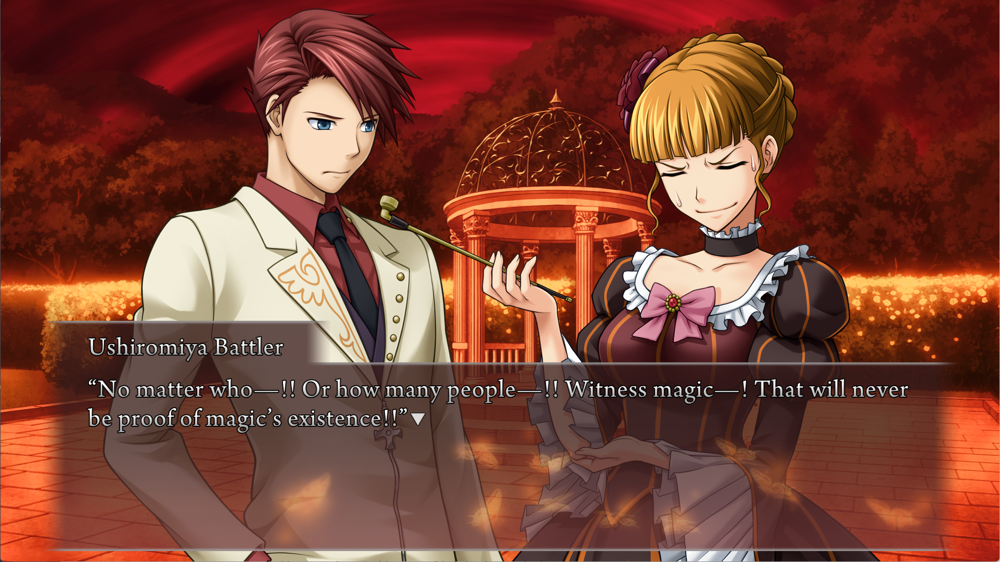
For him, it’s simply an inadmissible hypothesis. ‘As Battler is now’, Beatrice observes, he would argue through any magical feat she presented. She’d have to fight over ‘trivialities’ for each trick. She has now, she concludes, lost the ‘miracle’ of absolute determination she had at the outset.
Curiously, a pronoun is highlighted with ruby-text:
And…absolute, certain determination resides in Battler, ……leaving me with no miracle for certain.
I believe this is probably highlighted because it’s the first time Beatrice shifts from her previous imperious use of 妾, though I’ll admit I haven’t been keeping track.
She contemplates the brief connection that she and Battler experienced in Episode 3, during the tsundere routine. Beatrice, evidently, ultimately wants to be understood, right? This whole game is about that. And that’s why her ‘victory’ in episode 3 had to be swept aside, ‘it wouldn’t be any good’…
As she contemplates this, she’s standing ‘crucified’ by a bunch of stakes representing Battler’s attack. Even Battler finds this an unsatisfying conclusion…
Beatrice states that the finishing blow will be a blue statement that witches do not exist. Battler refuses!
Battler: What I see there isn’t you losing. You’ve just resigned, decided you’ve had enough.
And his reasoning is much as we’ve surmised: even if witches are disproven, the actual whodunnit and whydunnit questions remain. Beatrice wishes for him to use his ‘favourite move’—that would be flipping the chessboard, right?
Battler faces Beatrice with an impassioned speech, demanding that she not hide her moves, that she explain why she’s been toying with everyone’s lives and she had better get back to the game so these questions can be answered.
Beatrice contemplates her fate: endlessly fucking with Battler or face the ‘tragedy’ that was promised when she became a witch. But apparently something Battler says gets through to her, because she rallies at last.
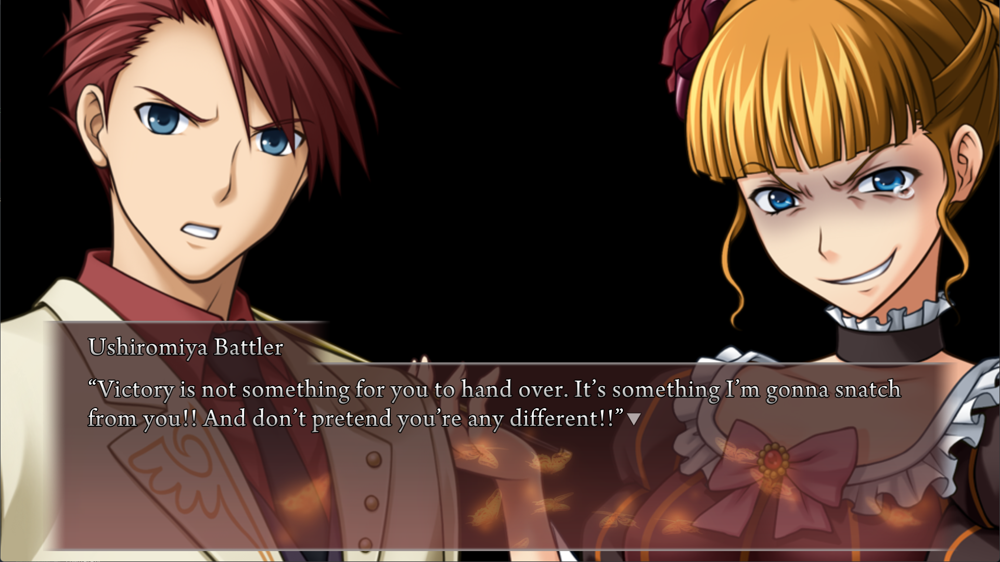
Reach heaven through violence!
Battler notes that Beatrice intentionally threw the game last time because it wasn’t a proper victory, and now he’s doing the same. Beatro calls him an idiot, just as he wanted. What an adorable pair.
So, we’re finally back in the game! Beatrice counters by conceding that…
Beatrice: Kinzo is already dead at the starting time for all games
Hahaha sick. Good job ferreting that one out, Battler. This does sadly mean we probably won’t get any more scenes of Kinzo screaming ‘Beatriiiiiiice!!’ to the heavens, flashbacks notwithstanding.
Beatrice continues:
Beatrice: “However, in that case, all I need to do is take one person out!! Thus far, I have been declaring that no more than 18 humans exist on this island. I will lower that by one for Kinzo!!”
“No more than 17 humans exist on this island!! That excludes any 18th person. In short, this 18th person X does not exist!! This applies to all games!!!”
Ohohoho. Good start, now if we just prove that for arbitrary N>0, if no more than N people exist on the island, then no more than N-1 people exist on the island, and we can prove by induction that nobody exists at all!
But yeah, since Battler’s theories all hinged on the person X, this is pretty much the expected play. But also damn that puts us back the drawing board entirely!
However, since we now know that the depiction of a character is not grounds for assuming that they are real, we could perhaps reason that another character is actually fake. Since every other character has multiple eyewitnesses to their existence, this is harder to fake than Kinzo. The question is, are there any characters who are never seen by other people to be in the same room together?
I’m kind of thinking of Sayo and Kanon right now as obvious ‘outliers’, with quite similar character designs, and also there’s the whole ‘humans as furniture’ theme running throughout the story… and ‘Sayo and Kanon are the same person’ would be a wonderful shot in the arm for my ‘transfem Kanon’ theory—also such a person would be a great candidate for author!Beatrice.
However, these two interact a lot on camera, sometimes with other characters present, notably including the extended stint in the dungeon during this episode. Is Battler present for any of these scenes? I thought Kanon went to fetch them from the beach during episode 1, but now I check, I’m not so sure.
What about situations where Sayo and Kanon are in physically separate locations? Well, since we only have Battler’s POV, there’s no way we could verify that..? Also, more problematic, there are games where one or both of the two is killed and their corpse is found. Although, it’s possible that there is some other dead body on the island…
We’ll put a pin in this one.
Battler is, bless him, not deterred by this counterplay. He gets straight to it. I’m not going to number them, but I will quote every bit of red and blue text we’re given.
The endgame
Episode 1
Battler: There is nothing strange about the murder of the six relatives that were found in the gardening shed in the beginning! The crime was possible for any of those who didn’t have an alibi
This is conceded.
Next, Eva and Hideyoshi in the locked room. Beatrice immediately spins up a few red axioms to constrain us:
Beatrice: Both deaths were homicides! It is not the case that, after the construction of the locked room, one of them committed suicide after murdering the other! Furthermore, the murder was carried out with both the victim and the perpetrator in the same room! No method exists for the perpetrator to commit murder from outside the room
Battler immediately responds in blue, with the ‘perpetrator hid in the room’ theory, coupled with deception with the dead bodies at the start:
Battler: Suppose that the culprit was a human without an alibi. In other words, the dead! Among the first six corpses, there were some made unidentifiable because their faces were smashed.
One possible theory is that one was actually a fake corpse, and that some culprit X killed those two after pretending to be a victim and hiding away! Then, after the locked‐room murder was constructed, the culprit hid under the bed, and waited for all of us to leave!!
Beatrice accepts this play. The next subject is the death of Kanon. This time, we have these axioms:
Beatrice: All of the survivors have alibis! Let us include the dead as well!! In short, no kind of human or dead person on the island could have killed Kanon!
Battler counters with a suicide theory:
Battler: If no one could kill him, then he might have been the one to kill!! Meaning Kanon‐kun might have killed himself.
A repetition request gets this one shot down:
Beatrice: Kanon did not commit suicide.
But she will not repeat ‘Kanon’s death was a homicide’. So neither a suicide nor a homicide… perhaps Kanon died of disease? Battler goes with an accident instead, which makes a lot more sense given the stake… I forgot about the stake, it’s been a while!
Battler: Kanon‐kun died for a reason that was neither suicide nor homicide. Though the circumstances are unclear, he died from an accident.
By the Devil’s Proof, I refuse to explain what kind of blunder could have led to an accidental death where a stake was driven into his chest!!
I love this line. Incredible stuff.
Beatrice concedes the point. However, it does not seem very satisfying. Another move would be to claim that there never was a living Kanon during the game, someone else was pretending to be Kanon, and they put a fake corpse down to throw off the scent. A third possibility is… Kanon didn’t actually die, and is only pretended to be dead? Given that in the next game, a seemingly dead Kanon seems to revive, this might be relevant.
But we don’t make that play, and instead move on. For Genji, Nanjo and Kumasawa, Beatrice declares:
Beatrice: Maria, who was in the same room, did not kill them! And of course, their three deaths were homicides!
Battler blames it on another fake corpse.
Battler: We can explain it with the one who carried out the murder being a culprit X who used an unidentifiable corpse to disappear. In the first place, their three faces were also pulverized. It’s completely possible that one of them was a body‐double corpse!
This time, Beatrice counters by ruling out all body-double theories:
Beatrice: I guarantee the identities of all unidentified corpses. Therefore, there were no body‐double tricks!
Battler responds with this one, which Beatrice calls ridiculous but accepts:
Battler: Then I can explain it with simultaneous murders. Each of the three had a gun, pointed it at another in a clockwise pattern, and they blew each others’ faces off at the same time! After that, Maria collected those guns and hid them!!
We’re definitely throwing out all thought of plausibility and motivation in these scenarios, but I suppose that’s the meta strat for the human side.
Finally, for Natsuhi… at the time it seemed that she had committed suicide, but now Beatrice rules that out:
Beatrice: Natsuhi’s death was a homicide! There are no corpses of unknown identity, and all of the survivors have alibis!
Battler counters with another one of his repertoire, the trap kill:
Battler: You can explain it with an indirect murder by trap X! Something was done to Aunt Natsuhi’s gun. You can explain it if that was a trap gun, built to send a bullet right into the forehead of anyone who tried to hold it up and shoot it!!
Fortunately this absurd idea is quickly shot down (ha ha):
Beatrice: The bullet buried into Natsuhi’s forehead was not fired from Natsuhi’s gun!
So Battler counters with a different trap theory:
Battler: There is the possibility that Aunt Natsuhi was lured out by that letter of unknown contents! And she was called out into the hall. Then, she was forced into standing at a specified location at a specified time, and murdered by some trap X, which used a gun that had been installed there beforehand!!
This display of, shall we say, ‘willingness to reach for creative moon logic’ is enough for Beatrice to concede the first game, ‘out of respect’. This chivalrous gesture immediately gets her pierced by a new blue stake.
Episode 2
The case of the chapel murders. Battler’s theory was:
Battler: Someone secretly borrowed Maria’s key, and secretly returned it to Maria’s bag after the crime was over
At the time this stood, but this time it gets shot down by Beatrice:
From the time Maria received her key to the instant Rosa unsealed the envelope the next day, the key did not pass into anyone’s hands
There goes that one! Battler runs through his other favourite plays, such as an auto-lock, a group of mutual kills, playing dead, or the killer hiding in the chapel. All of them get shot down by red, I’ll put them in this box if you want to check exact wording.
Red and blue volley
Battler: “There is the possibility that the door to the chapel had an auto‐lock just like Gramps’s study. In other words, it was unlocked before the crime, with a rock or something wedged in so that it couldn’t close completely. Then they gave the key to Maria. Because the lock was automatic, it is possible to make a theory where the key wasn’t needed!
Beatrice: No door with an auto‐lock exists other than Kinzo’s study!
Battler: The victims locked the door from the inside. One of the six was the culprit, and this person killed the other five, then pretended to be dead!!
Beatrice: The six were all already dead by the time they were discovered! All of their deaths were homicides! All six were pure victims; they did not take part in a mutual murder! There were no simultaneous mutual murders!!
Battler: There existed humans with no alibi at the time, e.g. Kumasawa‐san. If we assume that such a person killed the six, and was hiding inside, then there are no problems!
Beatrice: There was no one hiding in that chapel. Therefore, your ‘killer hiding in the building’ locked‐room scenario does not hold!
For all his talk about getting serious and returning to Ange, it seems like Battler is actually having fun at this point. He even pulls out the ‘dame da, zenzen dame da’ catchphrase! And then he goes even crazier with it…
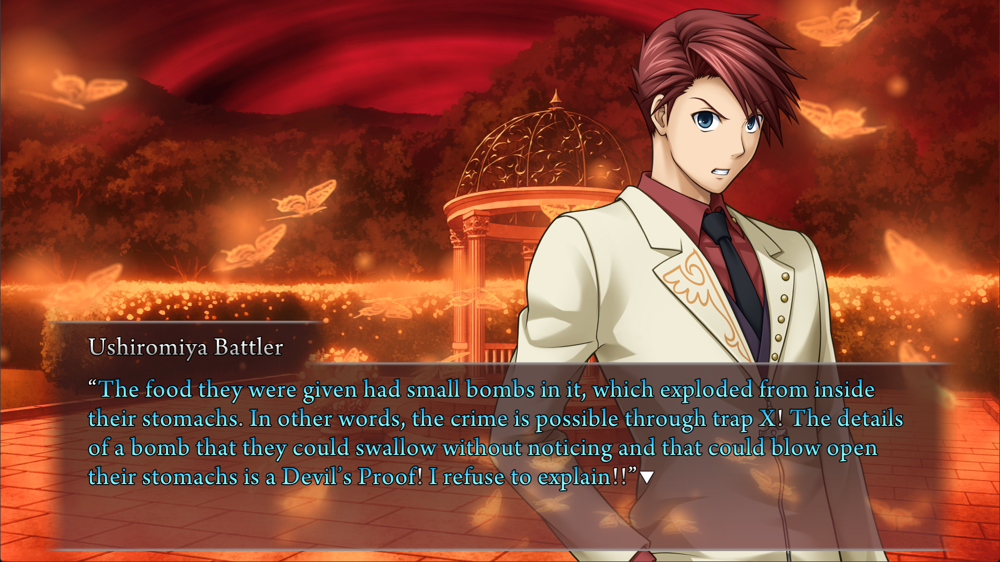
Battler: “The food they were given had small bombs in it, which exploded from inside their stomachs. In other words, the crime is possible through trap X! The details of a bomb that they could swallow without noticing and that could blow open their stomachs is a Devil’s Proof! I refuse to explain!!
I feel like if we’re going to posit technology this capable we might as well go with magic anyway… Still, though Battler’s specific hypothesis might be too out-there, maybe Beatrice has some reason she can’t rule out any ‘trap X’.
Perhaps Beatrice’s game is to force Battler into such a contorted position that magic seems reasonable by comparison..? But I’m not sure Battler would take that.
Next, the death of Jessica and Kanon. Battler has no trouble here.
Battler: If the culprit was one of the servants, they could have used a master key. It’s not even a locked room
Beatrice’s response focuses on the scene right after, where Kanon appears to reanimate and attack Nanjo and Kumasawa. Beatrice points out that Kanon’s death had been confirmed in red at this point. We get the following exchange which, given what I said above, seems crucial:
Battler: If Kanon‐kun’s death was declared with the red, there’s no way he was alive. Therefore, there is a chance that it was someone else in a disguise that would make the group that was attacked mistake this person for Kanon‐kun!
Beatrice: They would never mistakenly think any other person was Kanon!
Battler: Then, just like the heredity of Kinzo’s name, there is a possibility that Kanon’s name was inherited by someone. You could suppose that Kanon‐kun was killed, a different person succeeded his name, and this person attacked them!!
This one hits Beatrice ‘in a bad spot’. Maybe I’m grasping at straws here, but hmm… She notes that Battler’s playstyle has changed, and he’s accusing people of being murderers or accomplices without hesitation.
Battler’s solution to the deaths in Natsuhi’s room requires no revision. Beatrice accepts this blizzard of moon logic as an acceptable solution to the second game too.
Despite being stabbed over and over, Beatrice keeps up the trash talk. Mocking Ange’s death cracks Battler’s impassive shell.
Episode 3
Battler’s theory for the chain of six locked rooms was that Kinzo was the culprit and he had fallen into the boiler as a result of an accident. However, with Kinzo dead, this no longer works.
Once again we get a rapid fire exchange of red and blue.
Red-blue volley
Battler: There are plenty of people who could have committed the crime besides Gramps! You could even claim that the adults who were in the middle of a family conference at the time were all in on it and committed the crime together!
Beatrice: All five master keys were discovered, each in the pocket of one of the servants! The individual room keys were found inside envelopes alongside the corpses!
Beatrice: In short, all keys related to the linked locked rooms were locked inside the linked locked rooms!! No key could have been returned from outside the room using a crack in a door, a crack in a window, a vent or any place of the sort!!
Battler: Then they were killed with poison gas! Even if a key couldn’t pass through, gas could, right?! The murder was carried out from outside the locked room!!
Beatrice: All of them had fatal wounds that appeared to be gunshot wounds! Murdering them from outside the room would have been impossible!! I shall say more with the red!
Beatrice: When the five other than Kinzo were killed, the killer was always in the same room as them! I already declared in red at the time that there were no suicides!!
After running through his usual theories, Battler comes up with the culprit conspiring to pretend to find a key on a corpse, so the locked room was actually fake:
Battler: After the murder of each person in their respective rooms, the culprit constructed a linked locked room. But there was no way for the culprit to return the key for the last room to the inside of the locked room. But they did manage to return it. The first person to discover a corpse just had to pretend to find the key and pull it from the corpse’s pocket!!”
Beatrice asks why Battler would posit theories where Rudolf and Kyrie dunnit given that he intends to come home with them to Ange. Interesting question, actually, since it addresses the nature of bubbles, and how the characters in bubble scenarios relate to the ‘reality’..? Well, Battler doesn’t answer that.
Beatrice seems to be having a great time getting shot with lots of logical stakes and hearing Battler’s complicated theories. She really lives for this stuff… the ultimate gamer…
Battler says that the death of Nanjo in episode 3 is now the last thing he has to solve. This was after all the Eva Beatrice ‘checkmate’, so this should be interesting. But he’s convinced Beatrice has some final trick up her sleeve.
Once again we have Beatrice begging Battler to kill her… mockingly, of course. The ‘shot to the flank’, which was the ‘Kanon’s name was passed on’ theory, is mentioned again as causing her particular pain. Yeah, that’s significant.
(Beatrice’s trash talk focuses on the fun of ‘toying with people’s lives’. Easy to read this as just her pantomime villain persona, but I kind of wonder if someone with that sort of attitude is also at the root of whatever ultimately led to the murders…)
Battler spots a gap in the red argument. He seizes on a theory which I proposed all the way back then, that the deaths were not declared at a specific time! Yes!!!! Vindication!!!
To be more specific, Battler proposes the following semantics: the red truths apply at the game-board time they are declared, and Eva Beatrice’s declaration was some time later than Nanjo’s death. Ergo, someone killed Nanjo and then died themselves, perhaps by suicide.
In Battler’s words:
Battler's timeline-semantics Nanjo theory
Battler: ……True, the others probably were dead. However, the time at which their deaths were declared in red was not the instant Doctor Nanjo died. Strictly speaking, it was in the fight between me and Eva after Doctor Nanjo’s corpse was found.
In other words, if someone who was alive at the time that Doctor Nanjo was killed died before Eva proclaimed that death, you can sew right through that crack!! In other words, it’s like this.
The culprit was among those people who were not confirmed dead prior to Eva’s declaration of the deaths,and that person had managed to skillfully play dead in the beginning and wait for us to leave them alone…! They made us think that they had died, while their death still hadn’t been declared in red.
Then they killed Doctor Nanjo, ……and after that, they died for some reason! Then after that, Eva declared their death in red!!
I’m glad to have actually gotten one of these guesses right way in advance! Perhaps I wouldn’t be utterly fucked in Battler’s situation!
Following Battler’s theory, and the previous observation that details like the number of master keys vary between games, we can say that red statements are, for the most part, ‘scoped’ to both a specific game and a specific time. At least, we can say that for red statements that are propositional. For statements that don’t have a truth-value, like evil laughter or statements in the imperative, it seems you are free to use red for effect.
the end
Beatrice’s defeat(?) is marked by another variant of the stake animation and even a CG.
A new(?) piano track, titled ‘thanks for being born’, begins to play on the soundtrack. Beatrice begs for death.
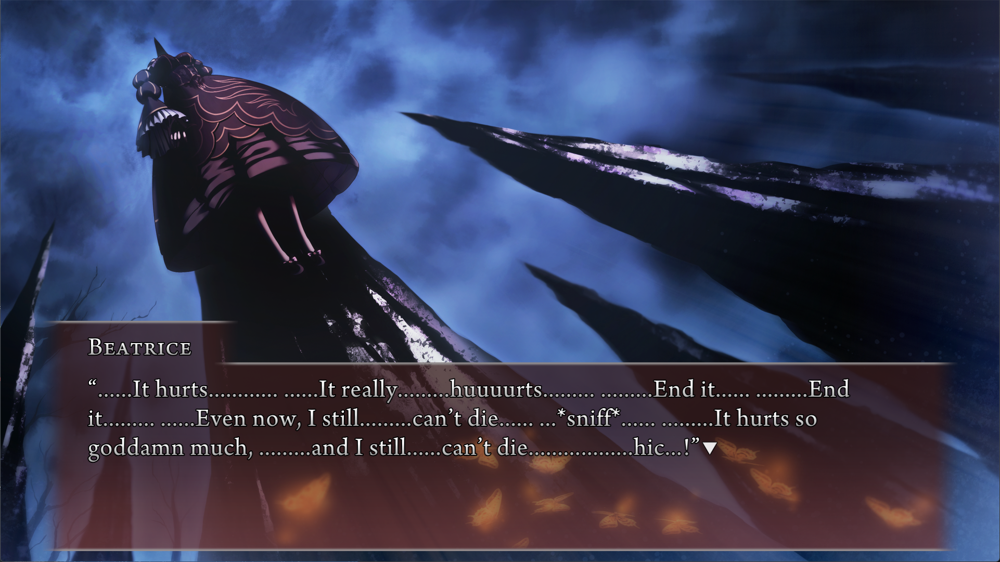
This time, Battler believes she’s not faking. He hesitates to pull the trigger. After all, even after this second round, it’s not like he’s learned the truth…
Beatrice declares she will lay bare her ‘heart’ (心臓) for Battler to kill her. And then… another transparent Beatrice appears, and says this:
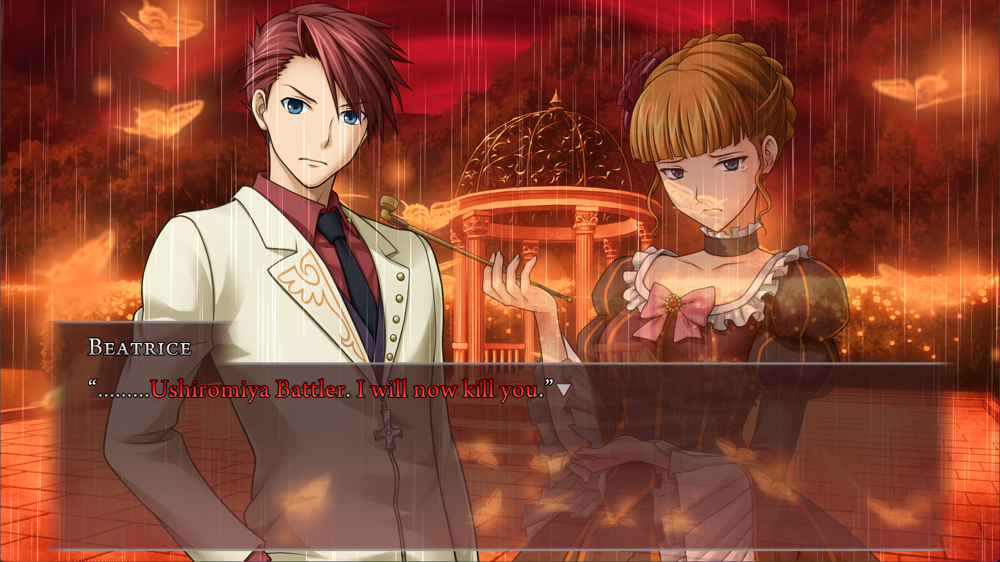
Battler: And?
Beatrice: And right now, there is no one other than you on this island. The only one alive on this island is you. Nothing outside the island can interfere.
I was confused about this, but Battler explains: there is one mystery left to solve, that of how Battler, now alone on the island after 16 of the 17 were killed, himself ended up dead.
Beatrice: You are all alone on this island. And of course, I am not you. Yet I am here, now, and am about to kill you.
She offers a final question: “Who am I?” We get one last CG of Battler embracing Beatrice, and then the endgame character scroll—to a new song with lyrics! The text here is just a list of every named character and the twilight they died on, but I will reproduce it here all the same, downscaled from a ginormous 1920 by 29616 image to a mere 800 by 12340…
Endgame scroll

Most of this is as expected (though I am not cross-referencing the list of twilights if that contains a clue). But one major detail that stands out to me is that Ange is marked as having died in 1998, presumably at the ‘jumped off a skyscraper’ moment. Which suggests the whole adventure she had in this episode wasn’t ‘real’? However, an alternative reading is that everything up to the confrontation with Kasumi is ‘real’, and Ange was gunned down on Rokkenjima at the end of her quest.
In any case… with that, we’re all but done! Just the ??? section to round out this episode, and the Question Arc as a whole.
We… won?
Phew, what a storm! I feel like this rapid-fire red/blue battle is like, the absolute limit of the form of Umineko we’ve known so far.
Beatrice has accepted all of Battler’s solutions here, but I’m not sure they’re all necessarily the best solutions. The bomb-food one, in particular, seems especially esoteric. It seems unlikely they will be revisited any time soon, though, since it seems the focus of the game will now complete its gradual shift from ‘is magic real’ to ‘who is Beatrice’.
Obviously, these solutions—taken together, or individually—do not offer anything like a complete, satisfying mundane interpretation of what happened on Rokkenjima! Battler had to reject this constraint to imagine that just about anyone could be a culprit, or accomplice.
Can we, from our safe armchair position, get any further than Battler? The next entry, on the ‘???’ coda to this episode, will probably be the place to try and pin down my final ‘post Question Arc’ theory, but let’s make some observations…
red statements
The pressing question for me is, can we strip red statements of their contexts and try to infer from them collectively? We learned something quite important about how red statements are scoped. This is most relevant for statements in the present tense. We have to observe when on the timeline these statements are made.
Although Battler observed that the number of master keys can vary between games, the number of master keys stated in red was five in both Episode 2 and Episode 3. Red text was not introduced in Episode 1. So just like Beatrice could pretend Kinzo is still alive, she could also insert extra master keys into the scenario.
The biggest problem with the ‘elided context’ theory is the question of Jessica’s death in Episode 2, vs. her alive-ness in Episode 3. We now know that ‘Jessica is alive’ is scoped near the end of the game; it’s likely she is killed shortly thereafter. Which comes a long time after her death in Episode 2. However, there is a solution to this. The red statement in Episode 2 went:
At the time of Jessica’s corpse discovery, only Battler, George, Maria, Rosa, Genji, Gohda, Shannon, Kumasawa, and Nanjo were in Jessica’s room. The corpse of Jessica is also included, of course.
This statement, unusually, does include an explicit time in red. The assumption in game 2 was that Jessica’s corpse was discovered at the time portrayed. However, this may be a clever trick by Beatrice. It is possible that Jessica’s corpse was discovered much later, near the end of the game. We do have the observation that a long list of people were in Jessica’s room, but it’s quite possible that most of them were dead. In fact, if we cross-reference it with Eva Beatrice’s list, it seems that only Battler would have been alive at this point.
Based on this ‘all red text is true’ theory, then, we can infer that on Rokkenjima Prime, Jessica was one of the last to die, and for whatever reason, most of the corpses ended up in her room when Battler, at that point the sole survivor besides Eva, discovered them.
Is that a valid reading? I’m not sure. We might want to go over and search for other implications on the basis of the ‘non-red eliminationist’ reading of the game so far.
As far as the question of whether we can delete other characters from the narrative—although we’ve established that Kinzo was already dead, and that names can be ambiguous, it is worth noting that there is no doubt that Kinzo existed, even if he was dead at the time of the game. And since multiple red texts refer to Kanon, we can be pretty sure that Kanon is real in some form. The same goes for Shannon (none of the red texts use the name Sayo)… and indeed, every one of the 18.
However, Battler’s theory on the name of slippery name ambiguity was accepted, so this argument isn’t perfect for proving that anyone exists as a distinct person.
We could destroy this ‘all red texts are true of Rokkenjima Prime’ theory by proving a definite contradiction. A lot of the red texts concern master keys changing hands and groups of characters being present in various rooms. Perhaps if I feel up to it I will try to establish a timeline on the basis of red text. However, I do kind of think I’m barking up the wrong tree here.
We should however observe that whether or not red text is scoped to games, within any given game, entirely ‘mundane’ scenes can be fake, not just the scenes with explicit depiction of magic. All of those scenes of Kinzo screaming BEATRIIIIICEEE in his room or nattering about chess with Nanjo? Fake! Every scene where someone talked to Kinzo through a closed door? Either fake, or someone was pretending to be Kinzo. I mean, ‘most scenes are not true of Rokkenjima Prime’ is kind of already a given with the time loop premise, but it’s good to be reminded that the solution to a particular game may require us to eliminate ‘mundane’ scenes as well as ‘magic’ scenes.
That said, the vast majority of the game is not red, and it would be silly to ignore everything. The games must surely imply something about the ‘true’ events, even if their relation is surely kind of oblique.
what’s probably true, even for the skeptic
Based on the recurring elements of the narrative, I think we can be pretty much certain that…
- there was a family conference on Rokkenjima
- the adults argued about the inheritance while the kids went away to hang out
Slightly less confident, but still very likely…
- someone who appeared to be the woman ‘Beatrice’ portrayed in Kinzo’s portrait appeared in the rose garden and gave Maria a letter
- Rosa berated Maria in the rose garden about the rose
- something significant happened at dinner
And in general we can probably say that…
- the general shape of relationships between the characters and characterisation is more or less as shown, e.g. Rosa’s neglect/abuse of Maria, Eva’s arrogance and pride in George, Battler and George’s ‘best bros’ relationship, Rudolf’s sleaziness, Krauss being a general failson, Natsuhi’s brittle pride, Kyrie being sharp and analytical…
There are some exceptions to this. I’m not convinced that George and Sayo’s relationship, and Jessica and Kanon’s relationship, are not at least significant idealisations. It just seems too unlikely for two of the four Ushiromiya siblings to have feelings for the servants at Kinzo’s mansion. Jessica is maybe more plausible since she actually lives there, but even so. (Also if the ‘same person’ theory is true, that would make it even more complicated. I would kind of love it if the hypothetical Sayo-Kanon was dating both George and Jessica though. That would be hilarious.)
Anyway, once the murders start, all bets are off. We can probably say that the characters were murdered over an extended period, and that the course of events had something to do with the epitaph ritual. It also seems likely that someone at some point solved the epitaph and found the gold.
As to the solution to the epitaph, we now have reason to think that there is an extensive network of underground tunnels connecting the main mansion to Kuwadorian, and that one entrance might be disguised as a well. We haven’t confirmed that for definite—Battler was not able to open the well and enter the tunnels—but this is the second time that major stuff has happened underground. It seems fairly likely the gold is indeed down there somewhere, although based on the ‘trust nothing that isn’t red’ principle, we can’t actually necessarily conclude that Eva discovered the gold as in Episode 3.
That leaves the question at the end: if Battler was the sole survivor and also Beatrice killed him, how can we resolve that?
Well, one solution is that Battler is Beatrice. I mean, a whole bunch of people have been Beatrice already: Eva, Ange, Virgilia. What’s one more to add to the pile? Sure, we’d have to make Battler a girl, but I mean is that a drawback?
A ‘Battler-style’ solution is actually pretty easy: some trap X or slow-acting poison X or food bomb X got him.
However, these answers both feel kind of glib, and don’t seem to really address the big ‘who am I’ question that Beatrice was driving at.
author!Beatrice and ‘bleed’
With any event in this game, we have a nested series of mysteries…
- the ‘piece’ level: can this be explained by mundane means, instead of magic?
- the ‘player’ level: why did the character Beatrice (or another actor with influence on the board such as Battler, Lambdadelta or Bernkastel) make the move to depict this?
- the ‘narrator’ level: why did the character we’re calling ‘author!Beatrice’ include it in the story she is writing in bottles and diaries?
- the ‘litcrit’ level: why might Ryuukishi07 have included this in the game? what themes does it address? etc.
The aims of the last three characters are not necessarily the same. For example, character!Beatrice goes through a huge variety of emotions, but author!Beatrice may be choosing to depict her in different lights for a broader purpose. Character!Beatrice intends to confuse and mislead Battler, but author!Beatrice seems like she might intend to use this character to leave breadcrumbs towards a real understanding of what happened on Rokkenjima, or obliquely confront her PTSD, or who knows what. Ryuukishi07 wants to write an entertaining story, and of course he’s got plenty to say through that story about the world beyond it.
I think in my haste to parse things through the author!Beatrice theory, I was too quick to identify author!Beatrice and character!Beatrice, interpreting character!Beatrice’s actions as codified versions of author!Beatrice’s feelings: when character!Beatrice decides to abandon the game, that would reflect author!Beatrice abandoning the project for a while. When Battler cannot remember his ‘sin’, that is author!Beatrice drawing a conclusion about her imagined version of Battler. However, this doesn’t seem to be giving nearly enough credit to author!Beatrice, who is clearly a very clever and creative writer with a great grasp of diverse characterisations. I’d go so far to say that she’s as good at writing as someone like Ryuukishi07…
So she could characterise her Beatrice character however she wants!
By that token, we can infer very little: we could say that she introduced Ange in this episode because it was a dramatically appropriate time to introduce Ange into the narrative. Indeed, we could imagine a continuum of possible author!Beatrices between one end where she’s basically character!Beatrice with heavy ‘bleed’ between her character and herself, and the other end where she’s basically Ryuukishi07 and motivated by similar dramatic concerns.
Still.. while we can’t necessarily believe the Ange arc happened as depicted, and so we don’t actually know for sure that messages in bottles were found by anyone, letters with keys to the bank vault were delivered, or anything of the sort, we do seem to have a pretty consistent theme (dating all the way back to the Episode 1 end scroll) that someone on Rokkenjima is writing this story, and that they are a survivor and witness to the events there.
With that in mind, I do still think I stand by the thought that she wants us to truly understand the weird world of Rokkenjima, and to do that she must lead us into the ‘magic circle’ that prevails there. Giving us a framework to understand the meaning of ‘magic’ in this narrative seemed to be the major thrust of this episode. Mariage Sorcière has also become a major theme, and assuming that’s real, she must have been involved in developing that with Maria.
OK, I think that’s all I have to say right now. What fun!
<See you next time.> for the very final chapter of Episode 4, and the long-awaited end of the Question arc!
Comments
j
been playing while reading this and finally caught up to where the blog stops! hope u keep playing it this year. theres a big hint about the last riddle thats kinda lost in translation - when the ghost beatrice asks “who am i” she uses the pronoun watashi instead of her usual warara. not to spoil too much but it’s definitely solvable! there are hints to the answer all over this episode