Happy new year, everyone! May 2026 be the year I finish reading Umineko, and embark on some similarly baroque work of fiction to match it. It ‘only’ took Ryuukishi four years to write this one, and June this year will mark Year 9 of the liveblog, but life is chaotic and I have meds now…
Chapter 12: Reasoning and Inspection
Chapter 12 opens with player!Battler in the abstract ‘Golden Land’ garden with Beatrice and Virgilia.
To the surprise of both him and Vi, Dlanor suddenly enters the garden. She greets Virgilia under her old name of Beatrice (so I guess the backstory/name-inheritance story we saw in Episode 3 is still worth keeping in mind…)
Indeed, speaking of Virgilia’s backstory, she claims that they are old friends in Heaven.
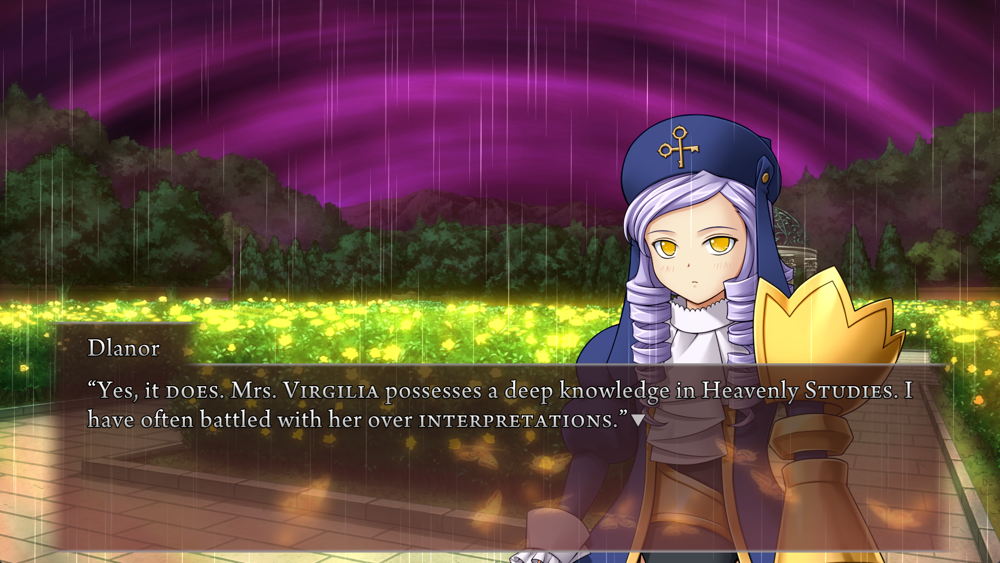
This is interesting because under the ‘witch as author/system host’ interpretation, in which Virgilia is something like a character created by/tulpa of Beatrice just as Sakutarō is to Maria, I had interpreted Dlanor as ‘belonging to’ Bernkastel’s ‘fictional universe’, but there’s a link here. Of course, if they are all creations of some sort of ‘author!Beatrice’, there is no problem.
Dlanor has apparently come to greet Battler, the ‘proper guest’ of the original ‘master’ Beatrice, though she knows full well that piece!Beatrice is ‘controlled by Lambdadelta’.
The narration (from Battler’s FPPOV) says that piece!Battler was also a ‘game piece of those witches’. So I guess we can put aside the speculation that Battler had come to take control of his piece? No, but this is confusing, because Bernie would have been acting against her own interests by having piece!Battler fight piece!Erika?? Dlanor tells Battler that she is playing an ‘opposing role’, and yet, isn’t she also there to deny witches..?
Virgilia prepares herself some tea with magic, and Battler prods Dlanor about whether she should object. She assures him that it’s acceptable for the ‘tale’ to write this as magic, even if Virgilia is using a secret tea set, by Knox’s ninth. Knox’s ninth says…
The “sidekick” of the detective, the Watson, must not conceal from the reader any thoughts which pass through his mind: his intelligence must be slightly, but very slightly, below that of the average reader.
Virgilia remarks that the ninth commandment is controversial, to the point that invoking it is a risky thing for the High Inquisitor to do. So Dlanor explains her principle:
“Magic that hides the result in darkness is evil. We will not permit it. However, magic that conceals the process is not necessarily evil. My foe is the evil, not the magic itself.”
So, the analogy here is between presenting a mystery and serving someone tea; the question, when it is appropriate to demand to see inside the kitchen. Magic can be a ‘white lie’, or as Virgilia puts it, an ‘embellishment’. As, for example, giving a small child candy and dressing it up as a magic gesture. If the effect is simple and the results positive like this, Dlanor says it would be ‘boorish and rude’ to go around questioning alibis…
Dlanor’s hardline stance against magic seems to be less a universal matter of faith, and more how she must act while ‘on the job’, and right now she’s off the clock. She remarks that her ‘pity’ for witches is itself a useless embellishment, which does not change the result of ‘executing witches’.
Battler and Virgilia disagree: intent, they say, does matter a lot. Real echoes of the 2010s arguments here… Indeed, Battler says that seeing this other side of Dlanor has already changed how he sees her. Virgilia is surprised and pleased—Battler seems to be starting to get the step towards understanding the ‘true nature’ of magic, which is to say, ‘understanding the “heart”’.
We get an answer to ‘whether player!Battler was controlling piece!Battler’ question. It turns out the answer is actually, according to player!Battler and Virgilia, that Lambdadelta was the one who intervened here, taking control of Battler to bolster the witch side a little against the overpowered Erika in order to get her desired outcome of a draw. So piece!Battler is somehow contested, open to influence by multiple people! That’s a fun wrinkle in terms of narrative authority…
Battler: ……Just what kind of mood’s taken those two? Trying to make it look all cool… They made me look like some kind of knight coming to save Beato.
So he actually doesn’t agree with this interpretation of him! However, Dlanor gives us some really crucial information about how the game works…
Dlanor: Yes, I am aware. However, pieces cannot do things that are impossible for them. And they specialize in actions appropriate to their original personality. ……Therefore, that was certainly something that you……that Battler was capable of. That is why I am grateful to you.
Even if piece!Battler is up for grabs, it’s not possible to make him act severely ‘out of character’. Which is a real epistemic coup for us, because we can still learn something even in ‘magic scenes’ and other unreliable narration. The power of the GM to construct a scenario is not absolute…
Anyway, Dlanor says that she actually intentionally threw the match earlier when facing piece!Battler. The reason is that she didn’t invoke the red declaration that Kinzo is already dead. Hm, I was wondering about that. I took it that the pieces are somehow not aware of that ‘higher-level’ declaration, but I guess not…
Actually, it’s more subtle than that!
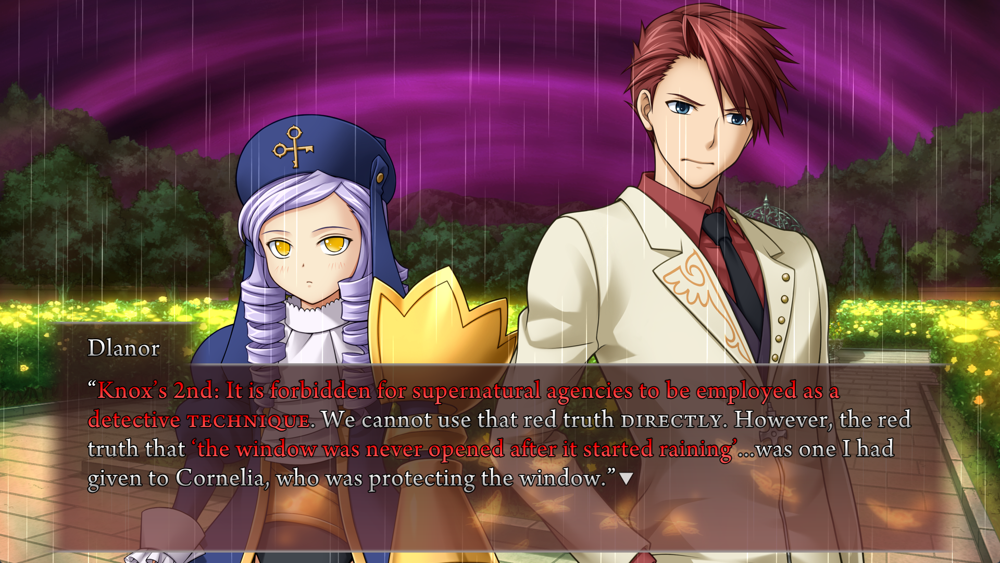
So here are two red truths to add to our library. Knox’s second law is actually more general:
- All supernatural or preternatural agencies are ruled out as a matter of course.
But the Umineko version is
Knox’s 2nd: It is forbidden for supernatural agencies to be employed as a detective technique.
I’ll need to make a list of the ‘Umineko versions’ of Knox at some point, we’ve gotten most of them by this point. Anyway, that means we can also have…
the window was never opened after it started raining
though I doubt it will be relevant for Kinzo’s mystery. Dlanor is not sure why the use of this ‘trump card’ suddenly became ‘forbidden’, presumably by Lambdadelta.
Dlanor further observes the same thing I did, that we’re spending an inordinate amount of time on the question of whether Kinzo is alive:
Dlanor: ‘Kinzo does not exist’ should already be an established fact. Lady Lambdadelta and Lady Bernkastel know this well. And yet, they are both leaving room for Kinzo to exist as they continue through this game. ……It is almost as though the two are conspiring to prevent Kinzo’s existence from being denied.
Dlanor thinks they have some ‘wicked’ ulterior motive. Something other than pushing the game to a win or a draw.
She sadly remarks that, while on the board, she will meet Battler as an enemy, in her heart she is always ‘neutral’ and finds Erika obnoxious and evil. She does not feel good about being called to this world…
Virgilia raises an interesting argument: while she may have been summoned by Bernkastel, Dlanor would not have been allowed into the game without Beato’s permission. (Under the author!Beatrice interpretation, she wouldn’t have been written into the story at all!)
Battler wonders what that means for Ange’s ‘uninvited’ arrival in the last game. But no answer presents itself…
Back on the game board, Erika is bullying Cornelia by repeatedly making her stand on one leg and pushing her over. Dlanor respawns and steps in, and Erika complains that she’s just a doll with no feelings to hurt…
But she’s taken out her anger and she wants to get her ‘little grey cells’ working on the main mysteries. She starts explicitly referring to what ‘the tale’ describes—the second time it’s come up this chapter, so let’s find out what word that is…
Erika: That’s right. The tale appears to describe that it was impossible for any of the humans at that moment, creating the illusion that an unknown witch exists.
Erika: そうです。一見、物語はその瞬間に、ニンゲンの誰にも不可能であったと語り、未知の魔女が存在しているかのような幻想を作り出しています。
And indeed, it is a very familiar word: 物語, monogatari. I guess this is the in-story term for what I’ve been calling the ‘narration’. One curiosity I notice here that’s probably true for a while: ‘human’ is written in katakana as ニンゲン, instead of the more standard 人間. I’ve noticed in various places that the script has alternative variations like ‘human’/’Human’ marked up, which don’t seem to be rendered by the game, and I guess now I know what that is based on in the Japanese. Curious, but no idea what it means!
Anyway, we’re going to deduce who placed that letter. This probably won’t be too problematic, since Battler and Erika only had eyes on a limited number of people. So we get this declared in red by Gertrude and Cornelia:
Before the family conference, Erika, George, Jessica, Maria, Nanjo, Gohda, and Kumasawa left the mansion and moved to the guesthouse
…
Of those who remain, only Krauss, Natsuhi, and Genji were in the second floor corridor, while all others were in the dining hall
Curiously, the position of the latter three on the second floor corridor is declared in red, even though it’s not directly observed by either Battler or Erika.
Anyway, Erika naturally posits that one of the three on the second floor placed the letter.
Erika: Most likely, one of those not in the dining hall—Krauss, Natsuhi, or Genji—simply saw their chance right after that and placed the letter there. No, in fact, it would have been possible for the people who supposedly went to the guesthouse too.
We’ve heard that the mansion was locked and that no one outside could get in, but if someone only pretended to go to the guesthouse and instead hid inside the mansion, it’s perfectly possible that they could have placed the letter there.
We’ve had it declared in red that they ‘moved to the guesthouse’, but this is still validated as a blue truth. But what about the knock on the door? Erika questions that it was actually that…
Erika: Firstly, I question whether the knock was even something hitting the door to the dining hall at all. For example, the mansion’s construction may be such that when a certain pillar on the second floor is struck, the noise is transmitted down the pillar, and it sounds just like a knock on the door to people in the dining hall.
Or they could have misheard some other random sound as a knock and misconstrued it in a similar way. Or a tape with the sound of a knock recorded on it could have been secretly playing, which had been carefully set up to be heard at exactly that time
The point about the mansion’s construction seems like it might fall afoul of a Knox rule. In any case, Lambda doesn’t hold off this time on countering with red.
Lambdadelta Krauss, Natsuhi, and Genji did not even touch that letter
Bernie takes over from Erika, answering this with another blue:
Bernkastel: when Shannon and Kanon came in to serve tea, who was the last human to enter the dining hall…? Let’s say it was Kanon. Wouldn’t it be easy if Kanon, the last person in, secretly dropped the letter there when he closed the door.
This leads to a much more absolute statement in red:
Lambdadelta Not a single person in the dining hall—no, there’s a simpler way to say it. Among all those inside the mansion at midnight, not a single one of them placed that letter in the hallway.
Bernie immediately seizes on the switch from ‘touch’ to ‘place the letter’, but Lambda says it’s only because when the letter was found, the others picked it up.
Anyway, this suggests that perhaps the letter was produced by sleight-of-hand by one of the relatives in the dining hall (an idea suggested earlier in the chapter, in fact, in the discussion of using ‘magic’ to give a candy to Maria!), and never actually placed in the corridor at all. I’m not sure if that’s consistent with the narration.
Bernie/Erika answers with a different hypothesis. There is a screen wipe to Erika halfway through, so it seems that Bernie’s directly puppeteering Erika at this point.
Bernkastel Someone who existed outside of the mansion at midnight placed the letter somewhere other than the hallway beforehand. Then, it moved by some means, and ended up “placed in the hallway”.
Erika: Just as an example, let’s say it was deliberately stuck to the underside of…the serving cart carrying the tea set, which the servants wheeled into the room. It was simply affixed there in a way that would make it come unstuck after a certain amount of time, such that when it eventually fell off, it would become “the letter left by a witch who shouldn’t exist”. In other words, this is a classic trick where the true sender gives themselves an alibi by making the letter appear at a different time.
OK, kind of convoluted, but it makes sense. Erika notes that the fact it appeared outside the door would be, in this hypothesis, just a coincidence.
Lambda doesn’t contradict this for now, instead returning to the knock. She says…
Neither Krauss nor Natsuhi nor Genji knocked!
This isn’t the limited meaning of them knocking on the door, okay? It means they didn’t use a pillar to transmit the sound or push the play button on a cassette tape they’d recorded or create that knock sound by any means! Of course, this includes all direct, indirect, intentional, coincidental, and unintentional means!
On further prodding, additionally it is stated (by Dlanor! who, curiously seems to be the mouthpiece for Lambda here) that…
Dlanor: At 24:00, except for Krauss, Natsuhi, and Genji in the second floor corridor, and all of the people in the dining hall, no other humans existed inside the mansion.
In addition to Krauss, Natsuhi, and Genji, none of those in the dining hall knocked, where “knocking” includes all direct, indirect, intentional, unintentional, and coincidental events that could create a knocking sound.
Completing the legalistic courtroom vibe, we get a definition of all the different types of knocking.
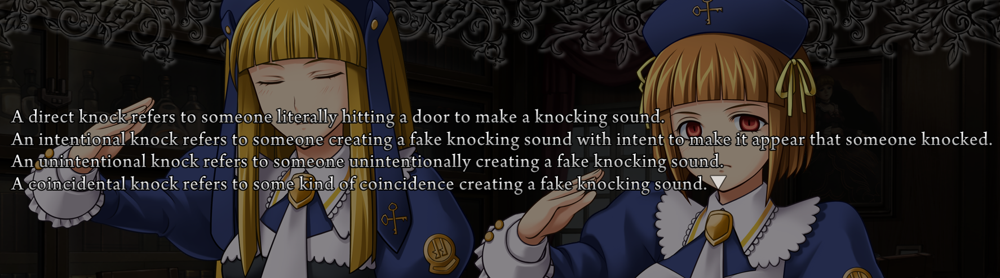
Dlanor: In other words, it is impossible for anyone who was in the mansion to have been the source of a knocking sound. ……In this case, “anyone” also includes any people who might have gone undetected or unobserved.
Erika retorts that this still leaves room for a tape measure to have been set up by the ‘guesthouse group’, including herself…
Erika: What if I, Furudo Erika, recorded a knocking sound on a cassette tape, secretly installed it somewhere, and set it up so that it would start playing at exactly midnight? Of course, I wasn’t in the mansion at midnight.
However, Dlanor points out the problem that it would be hard to use the knock to alert the relatives to the letter if Erika did not know where it fell. Lambda expands on this:
Lambdadelta: No one in the mansion placed the letter in the hallway. That goes for every conceivable possibility: directly, indirectly, intentionally, coincidentally, and unintentionally.
She says that this rules out the ‘serving cart drop’ method, since this would count as Sayo and Kanon ‘indirectly and unintentionally’ placing the letter.
Bernkastel requests a repetition of the claim that At midnight, only Erika, George, Jessica, Maria, Nanjo, Gohda and Kumasawa existed outside the mansion, in case someone might have slipped out briefly after placing the letter. After some promises, Lambda accedes to this.
Erika’s fallback is that the letter was attached to the ceiling instead of the serving cart. This is denied:
The letter never existed on the ceiling of the hallway.
Know that the letter never touched the serving cart
And even…
It was impossible for anyone outside the mansion to influence anything inside the mansion after the start of the family conference
Erika says well, some other ‘gimmick’ then. But she is denied the right to assert this in blue, since she has to be specific about what kind of trick. Erika naturally gets a little upset, but Dlanor recommends putting this aside for now, since the tape recorder theory is still sound.
Bernkastel ……………Well, let me see. Normally, I’d never forgive one of my pieces for the utter disgrace of surrendering, ……but if she’s managed to solve one of the mysteries, maybe I’ll let it slide for now……
With this setup, Lambda can demolish the tape recorder theory. We get:
Lambdadelta: None of the characters would misidentify a knocking sound.
Misidentifying a knocking sound means this: they would not mistake a sound very similar to a knocking sound for a real knocking sound. Hitting a pillar to make something similar to a knocking sound is no good. When you record a knocking sound on a cassette tape and play it back, it becomes “the sound of a tape with a knocking sound on it”, and not a knocking sound. So that’s no good either!
In other words, all of them would correctly distinguish a knocking sound of something truly hitting the door, and they definitely wouldn’t mishear it. It’s totally impossible that any sounds except hitting that door directly would be misinterpreted as a knock!!
Erika does not take losing well, as usual…
Bernie proposes an automatic door-knocking device. Yeah, I don’t think that’s gonna fly. Sure enough:
‘To knock’ means someone hitting a door with their hand!
To sum up, Lambda says
Lambdadelta: They heard a knock at the same time as the clock struck midnight. Everyone inside the dining hall definitely heard it at that time. And none of them would misinterpret a knocking sound. Krauss, Natsuhi, and Genji had no involvement in any knocking. No one else existed inside the mansion. And a “knock” refers to the action of standing directly in front of a door and hitting it with a hand.
Let’s see if we can do better. Given what we have learned about how the game board works, we know that events can be depicted if they represent a narrative that one or more characters are trying to present as the truth. So far I had been assuming that Battler is a reliable witness, but if Battler and the others in the dining hall had conspired to pretend there was a knock on the door and a letter had mysteriously appeared, perhaps to enact some scheme against Natsuhi, it would be legitimate to depict this perspective. Erika may be the only ‘detective’/’Watson’ character here.
God, so much back and forth just for a knock on the door…
Bernie goes in to give Erika a dressing-down for failing to think of the answer…
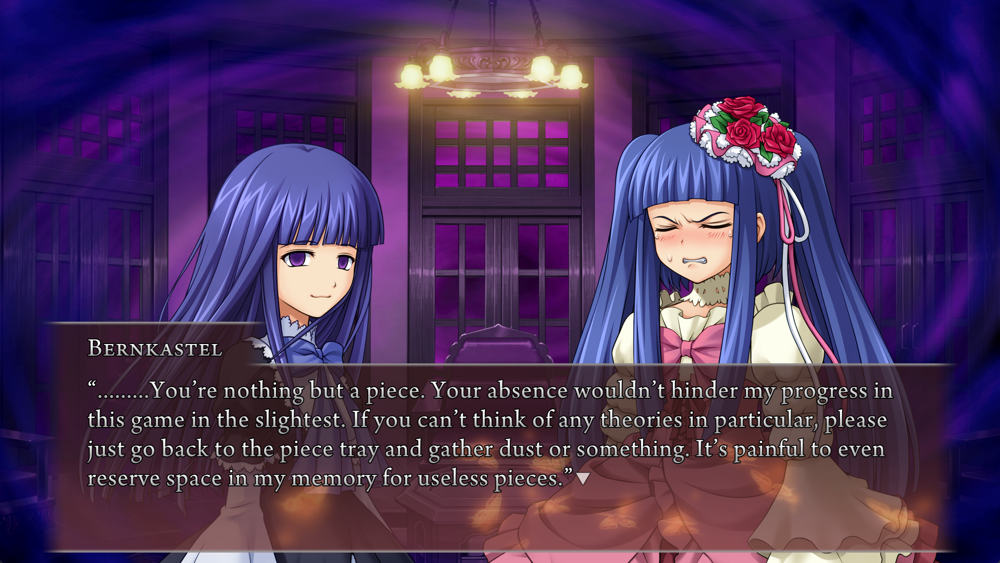
Yeah, I can see why she’s like that… Terrible bosses, these two.
We cut to Erika in the dining room in the present moment. She’s attacking Battler’s claim of having jumped down. Like we supposed last time, her idea is that he didn’t jump the whole way…
Erika: When you set up the ladder from the courtyard and saw Rudolf‐san go up it to the third‐story window, you closely observed the structure of the outer wall and realized that by cleverly using the rain gutters and other handholds, it would be possible to descend to the courtyard from the third‐floor window…! You didn’t jump down! You used the rain gutters and so on and clambered down the outer wall like a loser!
You have no rebuttal? Then my truth is valid, yes?! There, you see?! It may have looked like you jumped down all dramatically, but it was all an illusion! All you actually did was jump out and grab desperately onto the rain gutter…!!
Battler is unperturbed by this, replying that it didn’t really matter for his point how Kinzo descended from the roof. The narration, however, does confirm (if not in red) that Erika is partly right: Battler climbed partway down the rain gutter, and slipped partway down, but landed on his feet. Everyone’s already figured it out, the narration says.
Unfortunately for Erika, she seems to be on a different timeline, transitioning directly from the game board scene and bullying by the witches without the intervening timeskip? Whether or not that’s true, Erika invokes a lot of game-external talk on the level of the game board, openly referring to her ‘master’ and to blue truths.
A clumsy narrative hack in the form of a lightning bolt outside and an abrupt change in Erika’s demeanour makes everyone abruptly forget this happened. I guess she was disrupting the integrity of the game too much and Lambda had to slam the brakes… before long, she’s back to talking about chopsticks, and the chapter wraps.
The next chapter is titled Closet. I wonder who’s coming out! ;p
OK, that’s a wrap! My working theory is as above, that the ‘receiving a letter with a knock’ scene is depicting a deception and therefore doesn’t need to be explained. Notably, it has not been said in red that anyone actually heard a knocking sound or found the letter outside the door. In fact, the motive is pretty easy: they would like to position Battler as the inheritor of the gold, and having a mysterious letter to that effect is probably part of that scheme. Admittedly, it seems unlikely that Battler (who isn’t thrilled about inheriting the gold) would want to go along with this. So there are details to figure out. But still, I think the easiest solution is to say that Natsuhi isn’t the only one working a ruse on the island in this game.
With the red and blue being used so heavily, I’m starting to wonder if my rule of quoting every red and blue passage is really correct. Well, in fact, I’m already starting to skip over certain blue lines in summary. If you’re a reader, I’d be interested to hear: do you want the complete sum of everything red and blue, or should I brush over the blow-by-blow a bit more, and just summarise the overall thrust and stick to presenting my own theories? (I’ll still be writing down all the red, but I can put that in collapsible boxes and such.)
Other than that, see you next time when we will likely address something a bit more spicy than this creepypasta-esque ‘who knocked’…
Comments
omull (3b04304632159f24d070d8f3fd0b3eba)
I personally like how the quoted exchange helps me track the part you’re on. Your theories were very fun to read this chapter! Hopefully there will be more to come this year
felix
where did you go? :o
canmom (742623938c762ec774109eebb1c42915)
hey, apologies for the lack of updates! i’ve/we’ve been attending demoparties in germany and figuring out we’re plural and all sorts of shit. umineko updates will hopefully pick up this week or next, a bunch of writing is about to hit the site
saisai (44a1fc3390b5bc5cba4ad60ead47180f)
hi!! i know its been a while since you’ve updated this, but i just wanted to say that its really reassuring to see someone else who’s been reading umineko over a long period of time ^^
while i haven’t read too many of your posts, i really like your interpretations of what’s going on, especially as someone who’s been focused more on the emotional “drama” (that doesn’t feel like the right word but i can’t think of a “correct” one right now) of the characters rather than trying to figure out the mysteries themselves. i honestly feel a little guilty about it, but mysteries have never been my strong suit ^^; your posts have also been a good resource for looking back on some of my favorite moments so far (especially appreciate the inclusion of specific lines from the chapters!!), and your comments on what happens also serve as some nice food for thought on them. i hope you enjoy reading the rest of umineko!! (OuO)/