Hello again Umineko fans! Hopefully the detour into delving into the theory of roleplaying games has been interesting to someone.
Let’s pick up again. Last time, Erika Furudo has shown up under contrived circumstances and immediately attacked the riddle of the gold. Now the day is ending, and you know what that means: it’s time for some murders to begin!
Chapter 6: Those Who Reach It
We open with Natsuhi discussing the relatives’ doubts about Kinzo. It’s looking dicey. Even Beatrice is saying the ‘locked-room barrier’ is thin now. Virgilia proposes a change of strategy: they’ll try to create the illusion of Kinzo exiting the study and walking around.
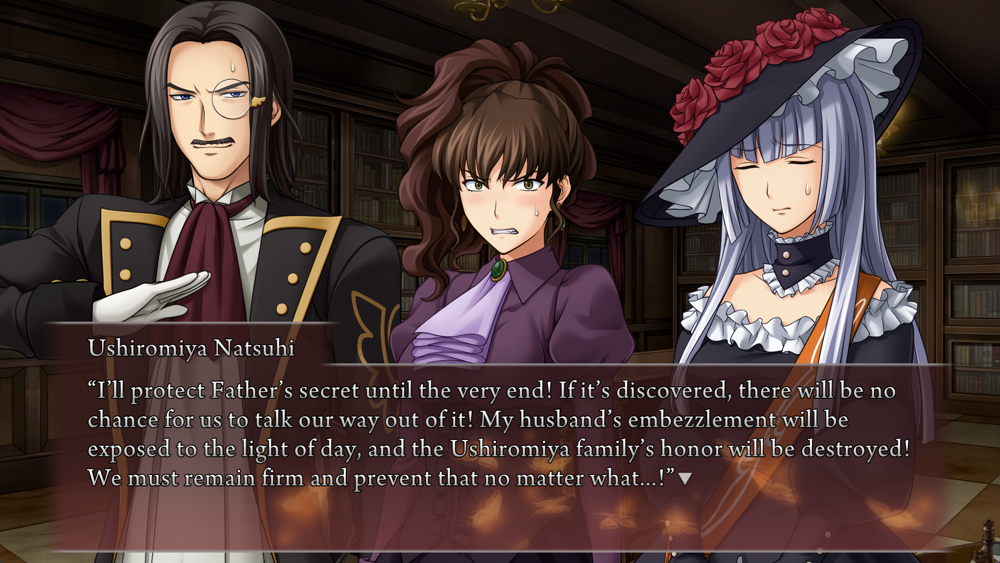
Natsuhi gives a little speech about honourably fighting to the last to cover up embezzlement.
Beato is pushing hard for the change of plans, but Natsuhi takes some convincing. She even mentions the Schrödinger’s cat metaphor. The witch crew talk openly about ‘Bernkastel’s piece’ and Bernie herself. Weird state where they are aware of being part of the game, but also not aware of the state of player!Beatrice in the world above…
They speculate that the ‘Natsuhi’s son’ character is a ploy to introduce a piece late in the game, similar to returning a piece to the board in shogi. (Curiously, Beatrice seems somewhat unfamiliar with Shogi, and mentions it in the context of describing Bernie as ‘a fan of Eastern things’.)
Incidentally, the names of shogi pieces go way harder than they do in chess? You can promote pieces and they get new names, so e.g. your ‘flying chariot’ (飛車) upgrades to a ‘dragon king’ (竜王)! The king has different names depending on the player’s rank, either a king general (王将) for the higher-ranked player, or a jewelled general (玉将) for the lower. (You also have gold and silver generals.) Anyway, the rule they’re talking about is known as drops in English. Once a piece is captured, you can respawn it as a move, with certain restrictions.
Ronove compares their predicament to a variant called ‘mating shogi’ (fufufu) in which only one player as a king, and their objective is to resist checkmate for a certain number of moves. Of course that made me wonder… the Japanese script says 詰め将棋 tsume shōgi, which apparently refers to shogi puzzles akin to ‘mate-in-n’ chess puzzles. It’s interesting to contemplate this kind of puzzle as a two-player game with a defensive player, rather than a puzzle where you have to explore all possible responses the opponent could make.
Anyway, Natsuhi has a panic attack but Beato gives her a “never stop thinking” pep talk. Natsuhi’s in the pits, though, going on one of her ‘be a good wife even though Krauss sucks’ spirals…
One thing that is quite curious here is that there is no real thought so far from Beato of performing the resurrection ritual. Beato’s goal seems, right now at least, to be about keeping Natsuhi’s secret.
The narration notes that Kinzo has not been seen in the study for some time now. So this is the ‘game board’ reflecting the fact that Bernie redtexted that Kinzo doesn’t exist?
Gaap pops up to interject with a suggestion: they could declare that Kinzo mysteriously went missing. They talk about the king running away in mating shogi (teehehee)… couldn’t they also go on the attack? I guess that’s not really such a good idea in shogi, since pieces can fucking teleport behind you whenever they get hit. (I love that Japan invented ‘nothing personal kid’ chess…)
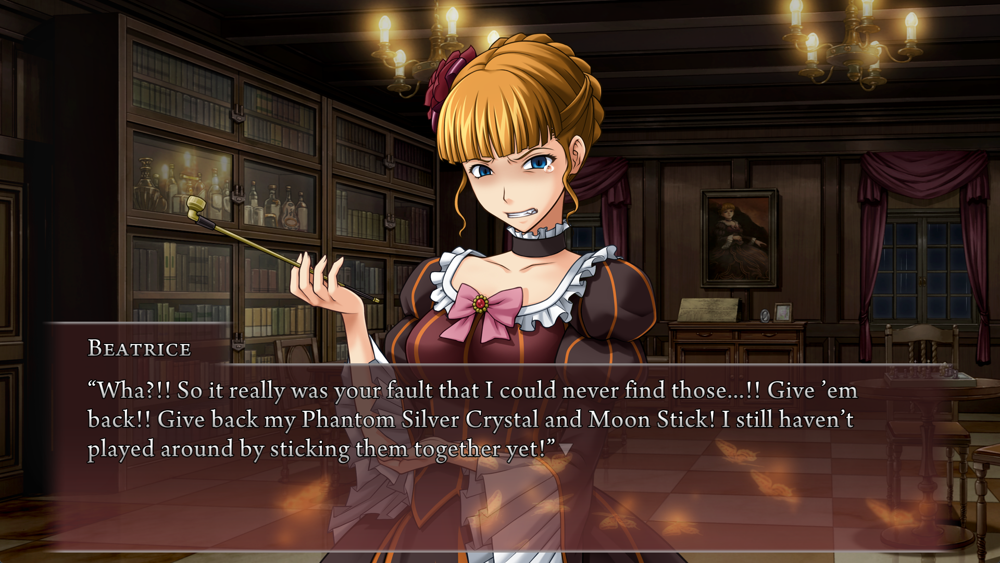
Gaap jokes about stealing Beato’s magic items as payment. Beato magical girl phase??
We cut outside to where Erika and Battler are still on that riddle.
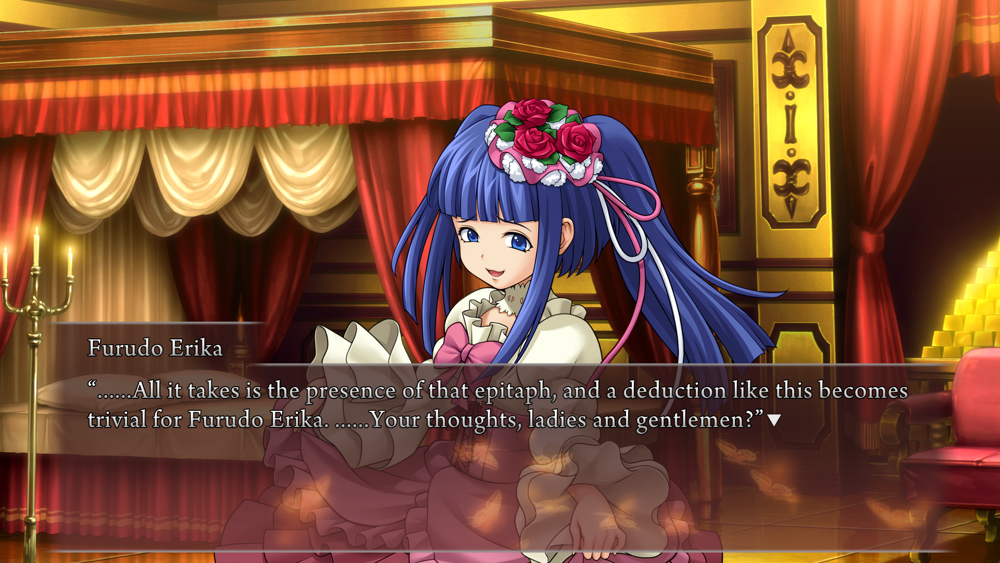
Erika: I see, ……so that was what ‘gouge’ meant after all. Once again, my reasoning was correct.
They’re interacting with some sort of gadget… so it’s not just a linguistic puzzle, there’s a physical component as well? How the heck are you supposed to figure that out with the information in eps 1-4… Anyway, Erika drops her long catchphrase. She needles Battler about how Jessica will feel when he gets the headship by finding the gold.
Battler is in good boy mode, though: he doesn’t want to be head and he says he’ll take a small portion and split the rest between the family. He becomes increasingly displeased with Erika’s tone. Then Erika says this:
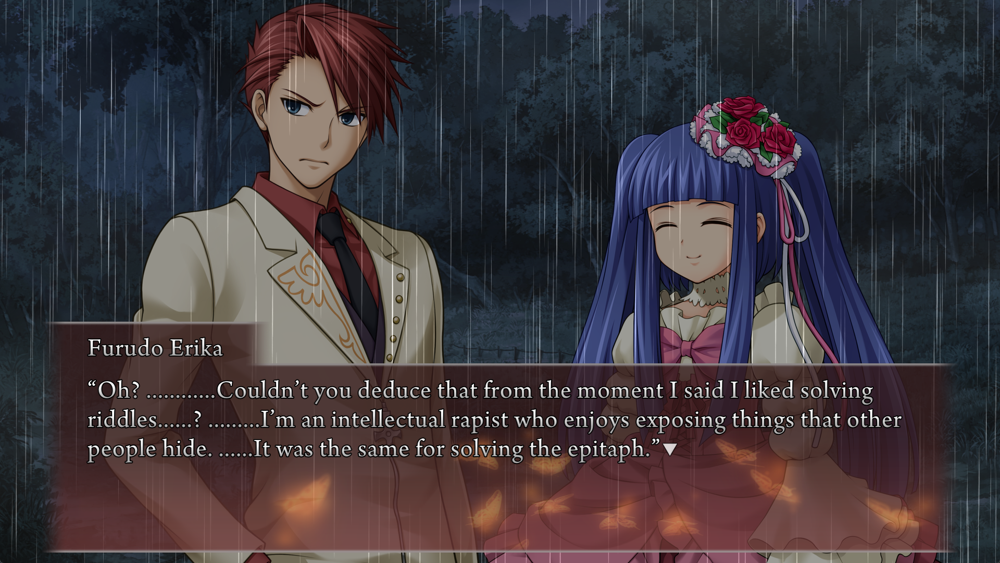
That’s some Insul-ass metaphor there Erika. Yeesh. I think that’s the first time the ‘r’ word has been dropped in Umineko.
The corresponding Japanese word used by Erika is 蹂躙者, a combination of 蹂躙 meaning ‘trampling down; overrunning; infringement; violation’ with the kanji for ‘person’. I think it’s nonstandard, or at least the full word doesn’t show up in the dictionary. There’s no really good analogue for ‘trampling-overrunning-violating person’ in English, I can see why they went for ‘rapist’ here, but also that’s a really charged word in ways I’m not sure the Japanese is, so maybe something like ‘sadist’ would be better, if less exact? Battler certainly doesn’t react with the sort of discomfort that someone saying this in English would usually elicit.
[note from the very near future: Apparently, the script in the PS3 version changed from the original! Erika originally called herself a 知的強姦者, for which ‘intellectual rapist’ is a pretty literal translation. I’ll get more into that in the next post!]
Erika says she is motivated to solve the riddle to get one over on Jessica, who interfered with her grandstanding. Wow, she really is a piece of work ahaha… she even does a fucking :3 face…

Battler glimpses a strange silhouette in the rain. He looks closer and recognises it as Kinzo. The vision of Kinzo silently communicates its approval and directs Battler’s attention to some part of the mechanism they’re fiddling with.
We get a final vision of Kinzo in a black void. He declares he has no regrets now that Battler has solved the riddle. Whose ‘truth’ is this now?
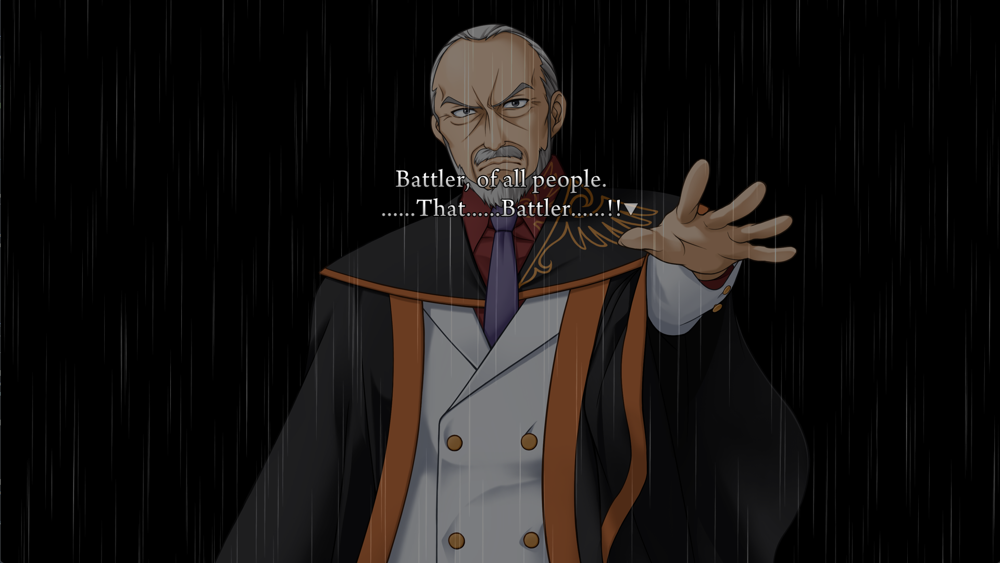
Oh, that Battler. I thought you meant some other Battler.
Battler meanwhile heads down the same tunnel that we saw Eva and Rosa go down in Episode 3 and finds the room with the gold. The narration compares the value of the gold to the 200 million yen lifetime wage of the average salaryman.
With even one one‐hundredth of this gold mountain……a single human could live their entire life without working.
What is labor?
Isn’t it the very point of a human’s life, since a person who doesn’t work cannot eat……?
If so, then 200 million yen is enough to make a single person’s life complete.
‘He who does not work, neither shall he eat’ is a Biblical aphorism, but also famously associated with Lenin. Not sure if the narration is intentionally referencing it here.
Battler observes that with this amount of money, 100 people could be freed from work for life. I like the way he thinks. But that does go to show the sheer scale of economics. This gigantic fortune is only a tiny fraction of how much ~economic value~ the population of a country like Japan creates.
We cut back to the game board layer. Lambda assures us that she kept the ‘really critical details’ hidden while teasing the solution, and Battler isn’t even that bothered. He observes that because only Eva and Rosa had found the gold in episode 3, its existence might have been another ‘catbox’ falsehood. (At the time, I was working on the assumption that any scene without explicit magical elements could be trusted, so I didn’t even consider that!) But now we have the eyes of our ‘detectives’, Battler and Erika. Lambda gives us the red to confirm it.
Lambdadelta This mountain of gold is the real thing. All of the ingots piled up here are real, pure gold! There are absolutely no tricks such as replicas or fakes!!
As for Battler’s vision of Kinzo, that merits a blue hypothesis:
Battler: I was probably in a state of euphoria after solving the epitaph’s riddle. And that caused me to mistake something for Grandfather.
For example, maybe that was some kind of sheet or cover that had gotten caught in a dark grove of trees, which looked like Grandfather wearing a pitch black cloak! As a result, I mistakenly thought that I’d had some sort of conversation with Grandfather.
Seems like it would be simpler to call it a metaphorical depiction. But in any case, Bernkastel remarks that she made the same blue hypothesis, and it had not yet been denied…
Battler concludes that with Erika in play, there’s no covering up the discovery of the gold.
We end with a deployment of the catchphrase, second time this chapter.
OK, so, gold, definitely real, and also it seems definitely on Rokkenjima! Which is already what I thought but hey.
One fun wrinkle of this is that this time, the pieces know more than the players. Usually the opposite is true. By eliding the scenes where Battler and Erika solve the riddle, Lambda has created this ambiguity…
It also I guess indicates a bit about how the GM role works? Bernie is ‘controlling’ Battler and Erika, but they seem to act independently to carry out her intentions..? And Lambda does not directly control the characters, but she can use the ‘camera’ to screen different ‘truths’, which might be fantasies or lies. Does the GM also have some leeway in how that ‘truth’ is narrated, like introducing characters like Ronove, Gaap and Virgilia to Natsuhi’s mindscape?
Honestly… if Beato does come back from her coma to the temp GM and her girlfriend pulling all this shit, she’ll be so mad. But hey, it’s definitely keeping things spicy. For real, though, I think it is really cool how the pacing and vibe of the story has really noticeably changed with Lambda driving. She’s less concerned with questions like characterisation or building up the web of emotional connections; basically everything we’ve seen so far is about setting up the mystery. Though, to be fair, she can build on everything Beato has built up in the last four episodes.
Horrible analogy time: Beatrice is a sort of stereotypical 90s railroad GM, with a heavily planned-out story she’s leading the player through designed to have lots of emotion and drama. Lambda is more of an old-school D&D referee, who sees the game as posing a series of challenges for the players to overcome… or perhaps it would be better to say she’s a kind of 2000s D&D DM, with a big focus on interacting with a complex mechanical system? Either way, it makes me curious what an Umineko would look like in the hands of a 2010s emergent-story, shared-narrative-authority kind of group. Compared to a roleplaying game, I get the impression Umineko pieces have minds of their own, and I still don’t really understand what sort of influence their players exert over them.
In any case, Erika is definitely a minmax build as far as ‘pieces’ go. Her backstory is flimsy, her motivation entirely revolves around mystery solving. And given that motivation seems to be the main ‘variable’ of Umineko pieces…
Although it’s not taken very seriously by Battler and Bernie, I think the vision of Kinzo seems like it will be more significant. Seems unlikely we’d spend the time to show that scene and highlight it in blue otherwise. Which means that, presumably, this is a clue that someone might be walking about pretending to be Kinzo? Someone who knows the solution to the epitaph? If so, that’s going to be interesting.
Comments