OK, final chapter let’s fucking goooo…
???? / Tea Party of the Unknown
Once again we have Battler’s corpse, pierced by the Lance of Longinus red sword of Dlanor. We get several paragraphs of description of this.
Player!Beatrice comes to visit the court, apparently not quite so comatose as she was before. Finding Battler’s corpse, all she has to say is…
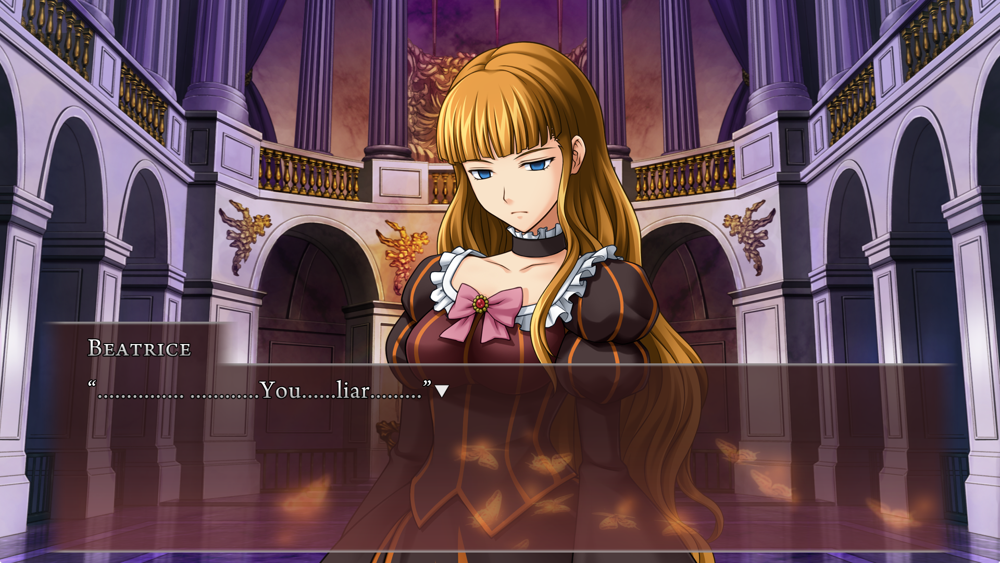
The prose here is heavy on the ellipsis. It’s kind of affecting honestly. She continues, using a series of familiar phrases even to a Japanese noob like me…
………ありがとう…。
……うそつき……。
…さよなら……。
そして………、
…ごめんね。
………Thank you…
……Liar……
…Goodbye……
And………
…I’m sorry.
…which, this particular phrasing hits kinda hard for me because sayonara, soshite arigatou (quoting Haibane Renmei) was how my friend Fall began her suicide note in 2022 >_< Haibane was using the same device, of using deceptively simple, everyday language to express overwhelming emotion. It’s scarred over enough now that that kind of thing doesn’t take me out all day. But I miss her…
So we pass back into Purgatorio, now cast in greyscale. This seems to be a memory, perhaps. The narration refers to player!Battler as ‘me’, so apparently this is now narrated from his perspective…? …haha yes the next line explicitly names this as a flashback, to one of Battler’s memories.
It’s the scene back in chapter 12 in which Dlanor met Battler in the garden. This triggers a new entry on the Tips screen on Knox’s ‘Decalogue’, or ten commandments, in the Umineko form we’ve encountered so far. The fifth (the racist one) is simply listed as ‘(not included)’. It suggests rev. Ronald Knox is actually Dlanor’s father, and adds…
The debate over the interpretation of these laws continues to this very day, and it has become the source of countless unfair controversies. While fundamentalists call any infringement upon these commandments heresy, revisionists point out that many canonized geniuses have violated these rules.
I think perhaps Ryuukishi has opinions on this one. The invocation of religious language certainly makes the point.
Battler continues a similar discussion in the narration, noting that there are many wonderful mystery novels with hidden doors (as an example)—but this must be established as part of the ‘premise’ (前提 zentei). Without that, there is no need for a detective to look for hidden doors.
I think it’s interesting to compare this with (surprise surprise) roleplaying games.
a little digression
In early roleplaying games in the D&D tradition, it would be common to fill dungeons up with well-hidden treasure and nasty little traps, and the players would be expected to describe quite explicitly how they go about searching for them. For example, in some version of the original D&D rules (quoted in The Elusive Shift by Jon Peterson), the example of play has the players searching a room:
By way of ascertaining what the room looks like, the caller sets the party to work with statements such as “We’re examining the walls, ceiling, floor, and contents of the room itself.” The referee then provides a detailed description of the gnolls’ lair, and through a process of steady inquiry into the details of the space, all phrased as specific actions such as “Each trunk will be opened by one of us” and then “Check the trunk for secret drawers or a false bottom,” the intrepid caller uncovers hidden plunder.
Dungeons such as the infamous Tomb of Horrors introduced a variety of convoluted punishments to catch out even experienced dungeoneers (the statue with the Sphere of Annihilation for example), with a degree of sadism becoming the norm at least in that kind of convention play. Of course, taken to an extreme, defeating this would slow the game down to a crawl, as the players would learn that the only sensible way to proceed would be to check every square inch of the dungeon for traps, hazards and secret doors.
Since that’s probably undesirable, later versions of dungeon-based games might choose to abstract over the process of searching with dice rolls etc., or just put the expectation on the GM to more or less overtly signpost in their narration when there might be something to be found. (If I want to flag the possibility of a secret door to my players, I might have another character disappear inside the room, or mention some markings on the floor…)
I don’t know if anyone ever proposed a ‘Knox’s rules’ for dungeon exploration, come to think of it. There are already so many differences of opinion on how best to do it… but nerds do love their lists of rules.
On that subject, mysteries are generally difficult to handle in RPGs, because there exists the possibility that players might simply miss a vital clue and never solve the mystery. The available solutions are all pretty awkward. For example, if you guarantee that the players will get the relevant information with enough abstracted dice rolls, then investigation becomes trivialised as a part of the game.
One particularly odd approach used in games like Brindlewood Bay is that there is no predefined solution, and instead the players get to decide what the solution to the mystery is. This sounds immensely unsatisfying, but I’ll admit to having never played this family of games.
Perhaps the real solution is to rely on human flexibility. If the players fail to pick up on your planned mystery, you have the option to adjust the story to better signpost it if you think it appropriate, or advance the scheme they failed to notice. It’s not so cut and dry as mandating ‘the players will always solve the mystery’—it’s part of a dynamic back-and-forth to give the players a puzzle that is just hard enough to be challenging to solve…
Battler is rather troubled by Knox’s rules. Being able to rule out secret doors based on genre conventions, he argues, is pretty structurally similar to the magic stories presented so far.
Dlanor argues that allowing arbitrary unknown hidden doors would undermine the whole integrity of a locked-room mystery. Basically, it is a fully general solution, which trivialises the puzzle. After a minute, Battler accepts this logic.
But of course the perversity comes when the players are aware that they’re in a Knox-obeying mystery, and they can start saying ‘well, the detective doesn’t need to investigate further because they would necessarily have found all relevant clues’.
Virgilia suggests this reflects a more general principle, that people are reluctant to solve problems without the guarantee of a solution. I think this is interesting because… mathematical research is pretty much all open-ended problems where you don’t know if you’ll get anywhere, right?
We get a flashback within a flashback, to Beato sneering at people refusing to try to solve because of a lack of information, and also for doubting information they are given; shortly after, she introduced the red truth. (Episode 2, liveblog 13). Which was an invitation to view the mystery as solvable, and even, Battler supposes, an admission she isn’t really a witch.
(To continue the analogy: mathematicians play around with different axioms to see where they go—whether they are consistent, whether they are independent, whether they can be used to describe structures we can imagine; here we are given a specific set of axioms that apply to this story. So it’s much more akin to being taught maths in a classroom than research. If the teacher poses you a problem, you can be pretty sure there is an interesting answer.)
So, the discussion establishes, Knox’s rules exist to assure us that the mystery can be solved by deduction. (Could there be a mystery solved by induction? Perhaps…)
And Battler asks the crucial question: does Umineko (“this game world of Beato’s”) follow Knox? Virgilia says she can’t answer; no guarantee has been given. Dlanor says it must be winnable… but Virgilia cautions that what Beato considers solvable for her might not be solvable for Battler. Ough.
As if to lampshade overseas fans’ struggles with the epitaph riddle, the narration adds:
For example, let’s say we pose a simple riddle that any Japanese person would be familiar with…….However, if the person we’re telling this riddle to is a foreigner with a Japanese‐English dictionary in their hand, it might be almost impossible to solve.
An English pun is provided as an example of such a one-sidedly solvable riddle. I’ll present it in Japanese:
ドラゴンはなぜ、昼間は寝てばかりいるのか
騎士と戦うためだから
Why do dragons sleep all day?
Because they fight knights.
In the face of this epistemic gulf, Virgilia gives us one red assurance…
Virgilia: Beato wanted you to solve it, so she created this game—and the riddles of this tale—to be solvable
Dlanor encourages Battler to try on her rules if he’s in a tight spot.
The scene closes out with an analogy to lovers who are reluctant to declare their love unless they are sure it will be reciprocated. Without love it cannot be seen, huh… Battler says relationships progress slowly, gradually communicating more and feeling it out.
Yeah, nine years into this liveblog, I get it haha. Interesting metaphor for the relationship between reader and writer. So what does Ryuukishi/Beatrice trust us with after we’ve shown we’re willing to play for five episodes..?
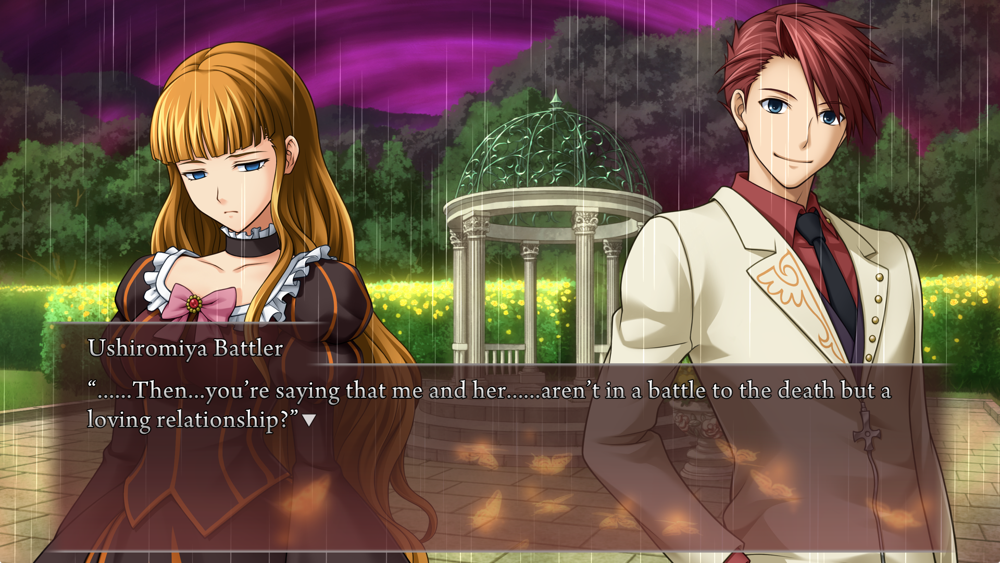
We jump back to the present where Battler is, apparently, not quite dead. He’s got all the time in the world to think.
Applying Knox (with Gertrude and Cornelia dropping in to reinforce), Battler establishes:
- Knox 1
- the culprit must be mentioned earlier in the story. So that rules out any Person X or later introduced character, it must be one of the original 18.
- Knox 2
- no supernatural detective techniques. Battler speculates that the culprit also cannot use magic. Cornelia refuses to confirm or deny. Battler concludes that if magic is shown, he must ask why, and consider who’s observing it. The narrator (author of the message in a bottle) is unreliable.
(At this point, he compares Virgilia’s red truth to someone passing a message like ‘Satou-san in Class A likes you’. Like, reiterating a theme, but it’s cute. He concludes that all of Beatrice’s taunting is a ‘tsundora’ thing. [the misspelling ツンドラ is in the Japanese as well, guess it’s in-character.])
- Knox 6 and 8
- All relevant clues must be presented, and it can’t be solved by luck. Beato [Ryuukishi] must have adjusted the difficulty of the game to make it solvable for Battler [fans at comiket]. Virgilia and Ronove were introduced for this reason.
At this point Gertrude and Cornelia pretty much straight up tell you to reread the story now you’ve been told what light to view it from. Eesh… that sounds like a lot of work. I mean, maybe if I didn’t liveblog it.
We get a rapid montage of scenes from previous games, and an explicit invocation of the Divine Comedy allusions in the previous games, and Battler says he finally reached the truth at the peak of Mount Purgatory. He wakes up in the courtroom, saying ‘you idiot’. To himself? No, to Beato. He awakes to find Beatrice just as she crumbles to dust.
A new song “Promise” with vocals enters the soundtrack.
Battler has the sort of mental breakdown you’d expect. He even makes the controller vibrate. (GF behind me: “Battler makes the controller vibrate to indicate his Lovense is going off.”)
Battler: Idiot…………idiot……… ……Your riddles……were too damn twisted……!! ……Why couldn’t……you say it…………more simply……? …You fooooooooooooooooool!! Aaaaaaaaaaaaaaaaaggghhhhh!!
If Battler’s mad at himself for not figuring it out in time to save Beato, what does the nine year liveblogger say…
Battler comes to life in front of the witch gang, turning the sword gold all symbolic-like (I guess now we add yellow to the repertoire of significant colours in Umineko? But no, it’s already well established as the Beatrice colour) and unimpaling himself.
Lambda is surprised, indicating this wasn’t part of the script. Bernie orders the Chiesters to open fire. Silly Bernkastel, you know this isn’t a suitable dramatic point for that to work.
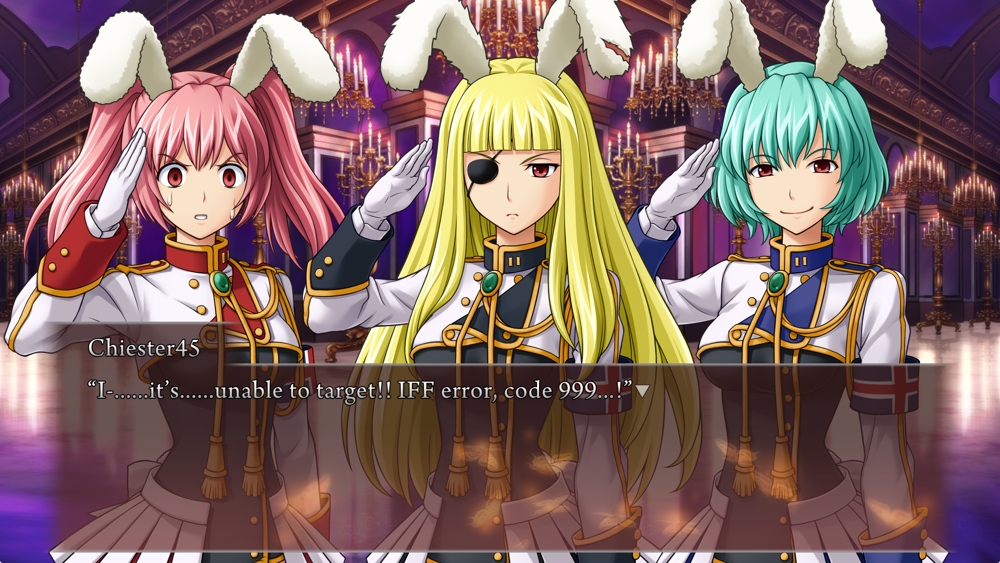
Here I turned around to show this screen to GF who’s only read a tiny bit of Umineko, and she completely lost her shit (“Why are they bunnygirls… why does that one have a username… why are they Icelandic… what happens in Umineko????”) so we might have found another reader ;p
An ‘IFF error’ suggests that the Chiesters’ system has identified Battler as an ally…
Lambda immediately declares that a retrial is on, overruling Bernie. Bernie tries to object that Battler ain’t even a witch. Well, we’ve seen how easy that is to fix, huh…
Just as we were about to get to that big reveal… I started getting hard drive failures on the drive holding the game, which promptly crashed, so this cliffhanger lasted for a full day.
So, it’s not that Battler needs to be appointed as a witch; rather he has just inherited the rank of Beatrice, much as Ange did before.
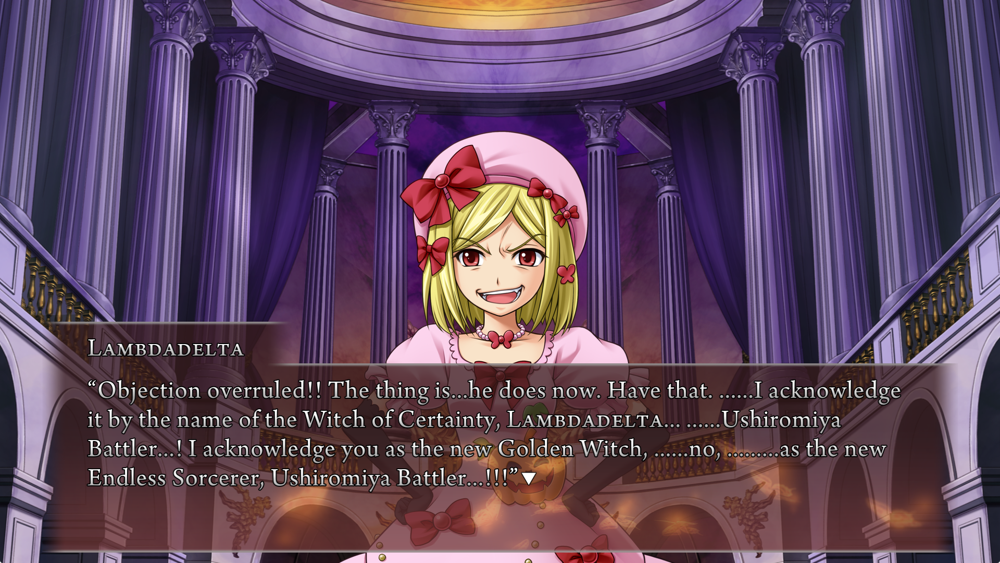
Though he doesn’t seem to get a smallcaps name to go with that.
We get an explanation of the Chiesters’ error: apparently Battler, by virtue of reaching the ultimate truth, is now officially the ‘territory lord’ (領主, which the dictionary renders ‘feudal lord’). Looking forward to the same happening to us when we catch up! I can’t wait to see what gold weapon we get.
This seems like it qualifies as the ‘detective announcing they’ve solved the mystery’ moment discussed earlier in the chapter. Although in this case the mystery is the ultimate mystery of what this whole thing is about. They seem to be fairly clearly signposting that we have all the information to solve it now, so… perhaps we should try? Then again, they probably aren’t going to spill it all right now.
Of course, Lambda wastes absolutely no time in relentlessly mocking Erika for having the title she just earned ripped away. Erika gives her the breakdown she’s looking for…
Erika: Battleeeeeeeeeeeeeeeeeeeeeeeeeeer!!! You think you can disprove my theory?! I’d like to see you tryyyyyyyyyyyyyyyy!!
It can’t be done, it can’t it can’t it can’t it can’t it can’t it can’t it can’t it can’t it can’t it can’t it can’t!! The theory I’ve created has no holes!! It’s impossible to rule out Natsuhi as the culprit!!
Battler’s counter is to argue that he can show Natsuhi isn’t necessarily the culprit, not to prove her absolutely innocent. He even says it in red:
Battler: I can construct a theory with someone other than Aunt Natsuhi as the culprit
The narration notes that Battler’s new status as a sorcerer is what gives him the right to use the red here.
So it’s time for Battler’s final round vs Dlanor…
Dlanor opens in blue:
Dlanor: Lady Erika’s reasoning has solved the fifth game. No new facts exist to overturn this logically derived truth…!!
Battler counters with perhaps the main thrust of this episode:
Battler: It’s possible to present a different truth using a different interpretation! When multiple truths exist in parallel, the authenticity of both is questioned!!
This is presented with an animation where he slices the screen in two and the top half waits a beat to slide down, classic Kurosawa duel style…
Battler’s going for a pretty wild twist, though. His theory is that he himself dunnit, as the baby from 19 years ago…
Battler: It’s possible to construct a theory in which this was the revenge of the baby from 19 years ago mentioned by Aunt Natsuhi in her confession.
Dlanor: Knox’s 1st: It is forbidden for the culprit to be anyone not mentioned in the early part of the story! A person first introduced in the fifth game cannot be named as the culprit…!!
Battler: What if the baby from 19 years ago was among us since the very beginning? For example, ……what if it was me?!
Dlanor: Knox’s 8th: It is forbidden for the case to be resolved with clues that are not presented! Was there ever any foreshadowing showing that you might be the baby from 19 years ago?!!
Battler: The red truth from the fourth game that I am not the son of my mother Asumu. The feeling that Dad was hiding something in both the first game and this game. In particular, in this game, it was made clear that there were some special circumstances having to do with my birth.
This is a pretty wild turn. Are we supposed to take on the theory that Battler, far from being an authoritative narrator, dunnit in all five games so far? That would be one hell of a weird reading. But OK, let’s see where he goes with this.
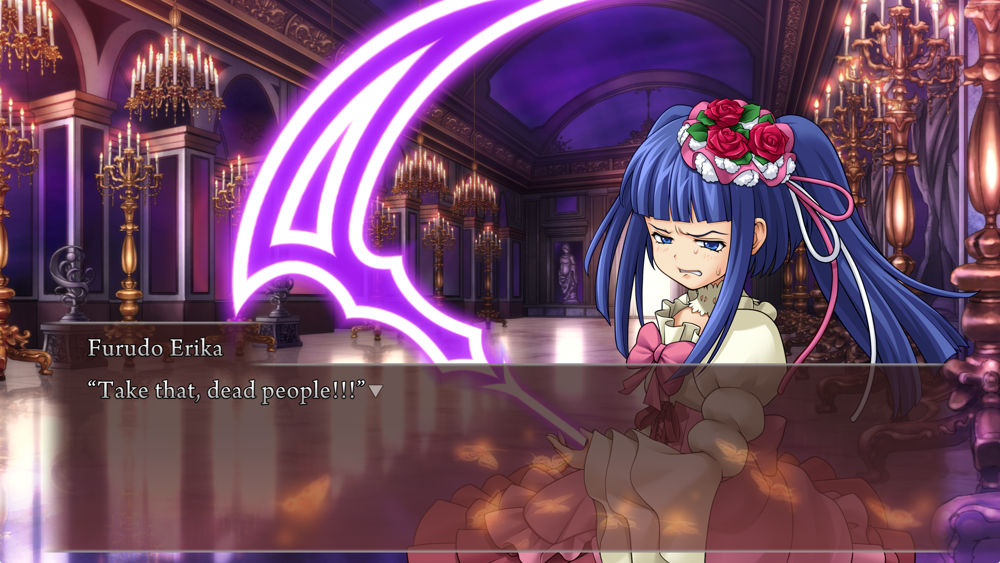
Also, Erika gets a new weapon too.
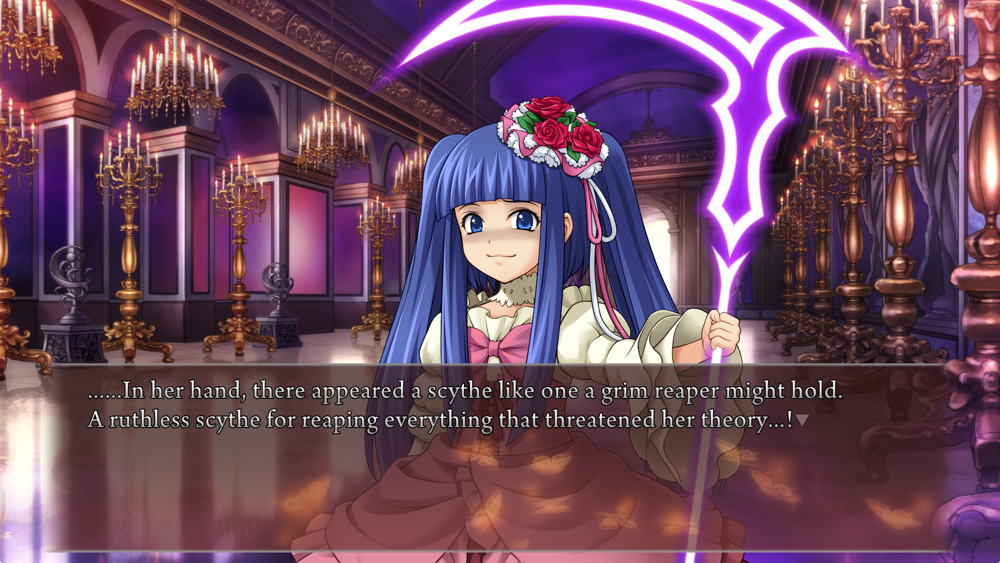
Ah, the classic chuunibyou weapon.
Erika fires a red-blue combo, which we’ve already addressed:
Erika: It’s only possible for the crimes to have taken place during the single hour after midnight!! During that one hour, you were in the dining hall of the mansion!! Therefore, it was impossible for you to commit the crimes!
Battler’s counter indeed focuses on when the murders happened. Are we going to address the Rosa issue..?
Battler: It has not been specified that the time of death was during the single hour after midnight. Therefore, it’s possible that the crimes didn’t occur between midnight and 1 a.m.…!
Erika counters:
Erika: It is impossible for the crime to have been committed in the cousins’ room between 1 a.m. and the time of the crime’s discovery
And Dlanor substantiates this with a Knox argument:
Dlanor: Knox’s 8th: It is forbidden for the case to be resolved with clues that are not presented. If the crime actually was carried out in the cousins’ room, clues must have been shown. Because clues were not given to the detective, Lady Erika, who was on the watch for any abnormalities inside that room until morning, such a crime is impossible…!!
Although this rules out the possibility of someone entering the guest house, hiding, and killing Rosa when she comes back, this seems to accord with our idea that
there was no noise until Battler screamed at 7am. shortly after this, people came running, and Erika ran off to check the whole guesthouse for anti-tamper seals. in this period, there is a small window where someone (Battler perhaps) could carry out murders
The murders might have happened at “the time of the crime’s discovery”: Battler killed his family members and yelled for ‘help’.
Is this Battler’s play? Indeed it is!
Battler: The “time of the crime’s discovery” refers to the point at which I let out a scream and everyone gathered there. Even if it was impossible to kill them before that point, it was possible to kill them afterwards
I’m pretty pleased to have predicted this!
Time for some timeline semantics quibbles. Erika tries:
Erika: The deaths of the four in the cousins’ room have been declared with the red truth
and after some back and forth, extends it to
Erika: The deaths of the four in the cousins’ room have been declared with the red truth!! And their dead bodies were witnessed by a large number of people!! And it’s already been declared with the red truth that no examination of any corpse is ever mistaken…!!
At that point, who should reenter the narrative but… Ronove! He gets a whole CG and everything.
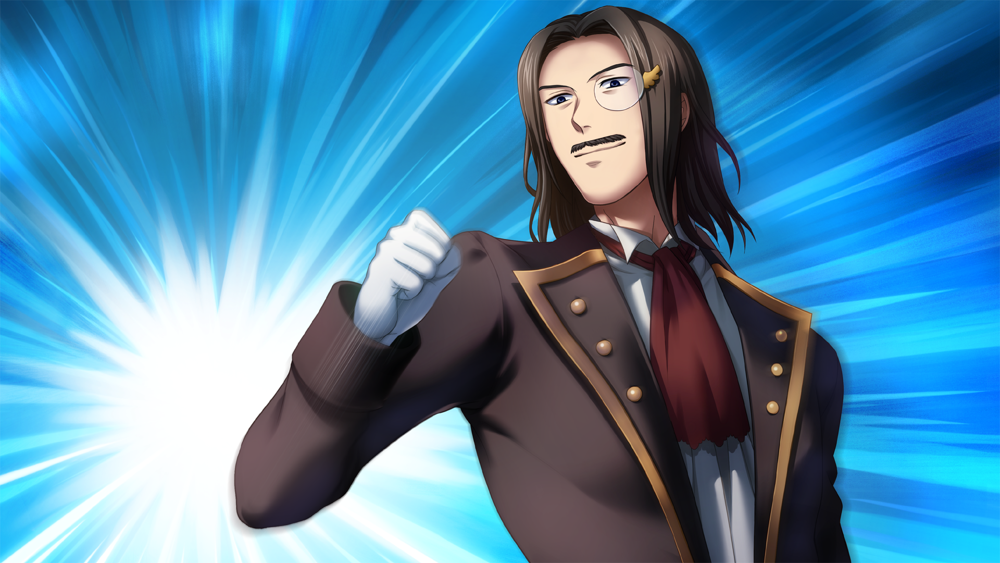
Ronove has such ‘guy you would meet at a LARP event’ vibes, doesn’t he?
Ronove: ……To what point in time did that red truth refer? Have you forgotten, Miss?
Erika argues that it can’t be left vague:
Erika: The red truth pronouncing them dead referred to what point in time, then, according to you?! Are you saying you can pinpoint that?! You can’t pinpoint it, so you can’t disprove that it declared them dead at the time of the crime’s discovery!!
But Ronove easily counters by assigning it to the clock time when the red truth was uttered:
Ronove: When this court was opened, Lady Lambdadelta made a proclamation. She said this was a 24:00 answer session
……They were pronounced dead at 24:00 on the second day, in other words, at the end of the game. That does not deny the possibility that the murder occurred after the morning of the second day, after the so‐called “discovery of the crime”…!
So this is actually closer to the ‘played dead’ theory I came up with: nobody was actually murdered that night. But what of the corpse identification problem? My theory was that ‘the cousins are dead’ was a conspiracy between everyone present except Erika, which gave Lambda license to portray it as ‘the truth’; nobody actually sincerely examined the bodies. Along similar lines, Ronove finds a loophole in the wording of the red truth:
Ronove: Did you see that yourself, Miss Detective…? True, it has been said that no examination of any corpse is ever mistaken no matter who performs it, ……but it has never been said that there was a rule against describing something other than a corpse as a corpse.
At that point, Gaap enters with the line ‘never leave your feet unprotected’, which merits another translator note:
This is a reference to a line in Dragon Ball that achieved meme status in Japanese, spoken by Kami/Hero/Shen in a fight against Yamcha.
Gaap’s attack is to invoke the ‘Kinzo is already dead’ redtext.
Gaap: ………Ushiromiya Kinzo is already dead at the starting time for all games!
Which is physically symbolised by, of course, dropping Erika in a hole which teleports her into the sky. Virgilia is there to finish her with a blue spear labelled smothered mate in a cheesy cursive font. The spear represents:
Virgilia: ……Shouldn’t you rethink your reasoning? Kinzo doesn’t exist. Therefore, the way for the bodies to disappear in your theory breaks down
Which is indeed a crushing logical flaw which Erika only left in because she wanted to frame Natsuhi for Kincest. (sorry.) The ‘smothered mate’ metaphor refers to a chess situation in which a king is trapped behind its own pieces, but attacked by a knight which can jump right over them, which seems quite fitting.
The Seven Sisters get in on the action too. They run through the six deaths, declaring that each one was never moved after death (presumably up until 24:00 at the end of the game, I assume they’d get funerals and such after that).
Asmodeus: After George’s death, his body was never moved!
Beelzebub: After Jessica’s death, her body was never moved!
Mammon: After Maria’s death, her body was never moved!
Belphegor: After Rosa’s death, her body was never moved!
Satan: After Genji’s death, his body was never moved!
Leviathan: After Krauss’s death, his body was never moved!
Lucifer: Therefore, the bodies couldn’t have vanished after being discovered!! Your theory about Kinzo carrying the bodies away breaks down!
The narration says being forced to revise is a small setback but a major wound to Erika’s pride. The demons gather to tell her how much she fucked up by trying to get mean with it.
Dlanor steps in, pulling out Knox’s second: all these unproven reds are against the mystery rules.
Dlanor: Knox’s 2nd!! It is forbidden for supernatural agencies to be employed as a detective technique! If you intend on showing that Kinzo has died with the red truth, I demand that you present evidence of a human truth supporting such a statement…!
So it’s back to Battler to put the last nail in Kinzo’s coffin… which amusingly puts him on the opposite side of the previous fight he had with Dlanor. Nice reversal, Ryuukishi.
Battler: Presentation of evidence. I present a body which can be identified as Ushiromiya Kinzo…!!
Dlanor: Can you prove that this is Ushiromiya Kinzo’s body?! No matter how much it resembles him, unless you can prove that it is him, it is possible to claim that it is a substitute corpse from someone else!! Can you show that it is Kinzo’s body with human truth alone?! In this one case, I will treat any rebuttal that uses only the red truth as invalid…!!”
Moving the goalposts a bit here Dlanor, but OK! Not sure where Battler found this body. Maybe in the gold room? But no, it would have to be presented explicitly. I don’t believe we reprised the furnace room scene in this episode…
Battler is ready for it, though. He seemingly concedes the point…
Battler: In this closed‐off Rokkenjima, there is no objective way to show that this corpse is Grandfather’s.
And that itself suggests the possibility that this corpse is a body double! This unidentifiable body cannot serve as proof of Kinzo’s death…!!
Erika: ……Checkmate…!! My theory is rock solid!!
Apparently the answer is… gold truth?? Which means I’m going to have to add a whole extra colour class to my CSS file. Also, dang.

So uh… what does that mean? If red truth can be deployed at the discretion of a witch, but requires unequivocal evidence if it’s deployed by a human… and blue truth represents an unproven hypothesis… perhaps gold truth is the special truth that is available for when you’ve understood the real mystery, seen with love, etc. etc.?
The gold truth, it turns out, is only available to the GM. It’s like… a super-red truth? Dlanor gives us something like an explanation…
Dlanor: ……Gold truth. A divine truth woven in a different fashion than the red truth. ……Its strength is on par with the red truth. ……It may sometimes be inferior. But it is sometimes superior!!
You only get gold truth when you truly understand Beato, indeed. I guess the argument is like: since you understand why Beato wrote this story, you know that she wouldn’t present a fake corpse instead of Kinzo: perhaps we could say that would be thematically inappropriate. It evidently supersedes Knox’s rules.
And indeed, Battler’s theory is promptly accepted by everyone except Erika. Lambda dismisses her pretty quickly.
So, having now made this case, Battler quickly wipes out Erika’s theory:
Battler: Grandfather’s absence has therefore been proven, and the dishonorable relationship between Aunt Natsuhi and Grandfather has been removed from consideration!! Aunt Natsuhi is pure and faithful! I won’t permit this vulgar tale you’re all so fond of!!
Natsuhi: ………B‐………Battler‐kun……!!
Battler: Furthermore. Because doubts have been raised about the time of death for all who have died so far, the alibis for everyone besides Aunt Natsuhi are null and void…!!
The argument that the crimes couldn’t have been committed by anyone except Aunt Natsuhi no longer stands!!
At this point I am starting to feel like my ‘make a note of every red and blue truth’ rule is getting a little strained. But, I can see the rhetorical necessity of having it in red.
Dlanor isn’t done yet, though. She counters with the Knox 7 objection: if Battler is the detective, he can’t have dunnit.
Dlanor: However, in the cousins’ room, you witnessed dead bodies which were impossible to misidentify…! Are you trying to say that was a falsehood?! …Knox’s 7th: It is forbidden for the detective to be the culprit!! The detective is obligated to have an objective point of view. Your theory violates this obligation!!
Of course, Battler isn’t the detective this time round, and he says as much.
Battler: Furudo Erika is the detective in this game, not me!! And by Knox’s 9th, observers are permitted to put forward their own conclusions and interpretations…!!
We get a little back and forth over whether it’s legitimate for Battler to stop being the detective…
Can Battler legitimately step down?
Dlanor: Knox’s 8th: It is forbidden for the case to be resolved with clues that are not presented! Until now, you have been the detective! Was it ever shown that you were not the detective this time, and that you were an observer with a subjective viewpoint?!! Unless it was, you do not have the right to falsify your point of view!!
Battler: In this game, when I figured out the device of the epitaph’s riddle, I witnessed Grandfather. ……As has already been shown in red, Grandfather doesn’t exist. It was impossible for me to witness him! Therefore, it has already been shown that my viewpoint wasn’t objective!!
Dlanor: It is possible that it was just a sheet or something fluttering in the wind and rain which you mistook for Kinzo. It cannot be used as foreshadowing to form a basis for Knox’s 9th…!! Mistaking things for something else is a right permitted to all observers!!
Battler: There’s the red truth which Beato showed during the fourth game!! No person would mistake Ushiromiya Kinzo by sight!
…
Battler: In other words, on this island, anything which might lead someone to visually mistake something for Grandfather, including someone else pretending to be Grandfather, cannot ever work.
…
Battler: Because of the right granted by Knox’s 9th, everyone is allowed to mistake a sheet in the wind for something else and talk mistakenly about what they saw. ……However! Mistaking it for Grandfather in particular is not permitted in this game due to the red truth!!
Which also adds the useful tidbit that any time Kinzo is on screen across the entire game guarantees that the narrator for that scene is unreliable, by virtue of Beatrice’s red truth that ‘nobody could mistake Kinzo by sight’ in combination with Kinzo being dead. That’s a fun, far-reaching projection of a red truth backwards… I’ll have to look for more of those.
Conceding, Dlanor narrates…
Dlanor: …………If a man like you had been in the world,you would surely have protected the fragile truth from any kind of arrogance.
Faced with the tyranny of a single plausible truth claiming to be the sole truth and exterminating all the fragile others, ……you would surely have protected the real truth…!!
Battler finishes it with this:
Battler: Therefore, my perspective in this particular game is based upon the ninth commandment, not the seventh…!! The fact that I claimed to have seen Grandfather is proooooooooooof!!!
In the face of this, Dlanor resigns. Erika calls her a “stupid half-wit murder doll” which, awawa. Battler tells her off for seeing mysteries as “nothing more than a weapon with which to sneer at your opponent intellectually”.
As for Erika, here’s Battler’s finisher:
Battler: I present a truth that conflicts with yours!! Aunt Natsuhi was threatened by a phone call over the internal line made by the man from 19 years ago: me!
His goal was to make Aunt Natsuhi look like a murderer…!! From the beginning, this has all been a drama of revenge intent on framing Aunt Natsuhi…!!
Erika tries to answer:
Erika: Th‐that’s wrong, it’s a drama of revenge against the Ushiromiya family planned by Natsuhi!! Your theory outright opposes mine!!
But since her theory can’t explain what happened to the bodies, Lambda tells her to get fucked basically. And of course Bernie doesn’t skip a beat in ripping a new one on the person she was just a moment before elevating to be a witch…
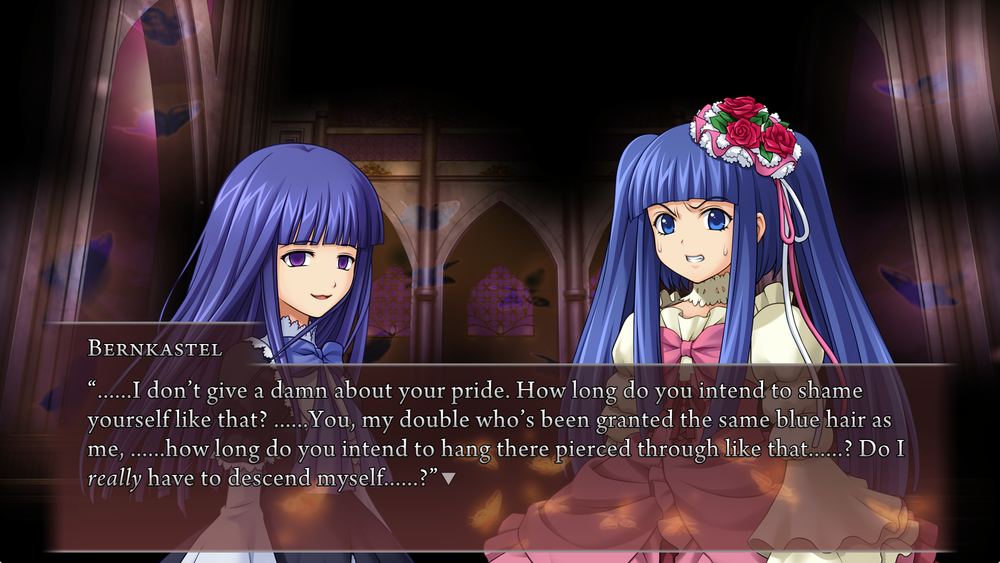
It took us far too long to figure out that being cruel to one’s selves/other people who arise from your head is generally not a good idea. Even if you think they are ‘yourself’ and therefore fair game. It does not work that way. But I don’t think Bernkastel will be getting on that ship for a while…
We are told rather than shown that Erika figures out a way to account for the bodies disappearing with ‘truly shabby reasoning that reeked of desparation’.
Battler doesn’t mind this. He declares for dialetheism: “Here, as many truths exist as you can imagine. No one can unilaterally deny them…!” Dlanor agrees, and declares she will protect Erika’s truth, even if it’s shabby. Kind of damning with faint praise there, Dlanor…
Having reestablished the ‘darkness’ of multiple competing truths, Battler declares that only he has the right to expose Beatrice’s truth. So I guess that’s what he’ll spend the next three episodes doing..?
Indeed, Lambda explicitly declares that Battler is now the Game Master. And apparently Erika will remain as the detective! OK, sure…
And rather than Checkmate of the Golden Witch, chapter 6 will be… well, we don’t get told just yet, apparently. We get a little CG of Battler and Erika clashing and then the credits roll.
Damn, OK! Turns have truly tabled indeed…
Since that turned out to be really quite a long chapter, I’ll save final comments on this episode for an afterword again. But, I see the shape of it now. Battler has in a sense ‘solved’ the mystery, which seems like it’s Ryuukishi (or author!Beatrice) telling us that we have enough information now and a suitable interpretive frame to get to the bottom of it ourselves. Shall we try? Seems like it’s worth a shot.
We get to see the final Episode 5 character screen, but so far as I can tell there isn’t anything we didn’t see in the episode. There is however a button to add glasses to Dlanor, so that’s cute.
There does not appear to be anything new in the Tips/Grimoire screen either.
…so, that’s a wrap! My theory for this episode seems to be… well, given that we are told neither of these theories is the definitive truth, maybe not proven correct, but at least pretty close to Battler’s counter theory. But what about the bigger questions like who Beatrice is, whether Battler is really conspiring to frame Natsuhi for murder, etc. etc.? And given the new interpretive frame, does anything come to light about prior episodes?
I’ll give it some thought in the afterword. For now, good night!
Comments
Branwen
Yay!!! Can’t wait for the afterward😊
effect
Just stumbled upon this liveblog yesterday after recently finishing umineko myself throughout the last month or so. It’s been a blast, I hope you continue to see this through to the end. I love the way the narrative both challenges and kind of rehabilitates Knox, here. Obviously, Erika’s munchkin style of detective-ing is missing the point, but she and Bern aren’t wrong to shit-talk most of Battler’s previous strats. Call it love, or call it honorable combat, more than anything this Episode is about the mystery genre itself, and the relationship between author and reader. Whether or not you subscribe to any particular list of rules, the game is assuring you that it is acting in good-faith. At this point is when I went back and attempted to “solve” all the previous boards. I did pretty alright, all things considered.