We’ve spent the last five articles examining RPGs in light of philosophy and game design.
Game design, huh.
- what is even the purpose of game design?
- can designers do too little?
- game-hacking in the 70s and 2010s
- can an RPG be played wrong?
- can designers do too much?
- incentivisation
- does this have a place in roleplaying games?
- freeform in the 70s
- so who’s responsible for what, at the end of the day?
- improvisational game design is actually the fun bit
what is even the purpose of game design?
According to Vi Huntsman and C. Thi Nguyen, the design of Suitsian games (at least) is a form of art, whose medium is creating a structure of agency for players to explore. Katie Salen and Eric Zimmerman would probably agree. Waxing poetic on the power of experiences games can offer, and lamenting the limited imagination of game design circa 2004, they lay out their purpose in writing Rules of Play:
This, then, is what is at stake: a vast discrepancy between the radical possibilities contained in the medium and the conservative reality of mainstream game development. And this is the way in which Rules of Play is more than a conceptual analysis of what games do; it is also an examination of what they can do, and by extension what they should do.
It’s an ethos I sympathise with a great deal—I work in game development, and I strongly feel the impulse towards creating a different type of game whose verbs and systems are not the usual ones. (I hope Shaderland can live up to that, and if not, maybe the next project will!)
But it can also take on a moral onus: as we’ve seen, in the 2010s (and tbh every other era of RPGs going back to the 70s), there was a widespread feeling that what happens at gaming tables was somehow broken, that players were having unsatisfying times with their roleplaying games as a direct result of the shoddy design of D&D and the play culture of the time. (This is not without basis: any RPG forum will end up accumulating many cases of players talking about things going wrong and asking for advice on how to deal with ‘problem’ players, or get players to engage with the DM in a different way.)
oh no it’s the Forge
Perhaps it’s not surprising, then, with such high-minded ideals in the water, that game designers would want to take a similarly ambitious, first-principles approach to the design of roleplaying games. We could posit this as what motivated the manifestation of the Forge, as something like a collective project to melt RPG design in a theoretical crucible (with idiosyncratic jargon as the alkahest) so that it could be rebuilt in a different way. To a limited extent, it succeeded at that, at least insofar as creating the ‘narrativist game jam’ as Vincent Baker would later describe it.
That is, at least, the most positive reading you can make of the Forge’s contribution to the history of RPGs: a noble but somewhat misguided effort, dragged down by its dogmatism and the toxic personalities of central figures like Ron Edwards, but nevertheless contributing a number of innovative game designs and broadening the possibility space of RPG design considerably. Yay!
However, you could also view this in a different light. The Forge could be accused of not so much trying to broaden the scope of RPG design as the opposite: Ron Edwards and his pals had a very clear idea of how they thought roleplaying games should be played, which they called Narrativism (in contrast to two other things they called ‘Gamism’ and ‘Simulationism’). People weren’t on board with Narrativism yet, so the Forge had to spread the good word and build RPGs to introduce people to the new way of playing, in the process making microcelebrities of the Forge’s designers.
In a way, this worked: many people found the ideas of the new Forge games and the following ‘story games’ movement revelatory. Although I missed the early days on the Forge, as someone who has a bad habit of picking up online ideologies, I kind of regret to say that I pretty much became an instant convert to story-games. (At the time, it was almost a kind of culture-war thing: story games were where the cool, trans, leftist people hung out; the OSR, to the extent I was even aware of it, carried a suspiciously reactionary whiff.)
A good few years on, the role of game design in RPGs and the theory that should inform it is still far from settled.
From the indie TTRPG designer side of the table, new salvos have been in made in the perpetual argument on how roleplaying games should be designed. These raise a central question: how should responsibility for creating the activity of a roleplaying game be divided between a third-party game designer and the players at the table?
On the other side, we have Vi Huntsman’s video which ultimately inspired this whole series. She views their intentions as outright nefarious: a behaviourist ideology which fancies game design to be a form of mind control that could be used to shape the behaviour of players, perhaps even outside the game. Though their aspirations are hopeless, she sees this moralistic sentiment as a powerful marketing for the brand of ‘indie story games’.
Compared to the familiar criticisms of the Forge (that they bog everything down with meaningless jargon, and that the GNS model simply draws a false trichotomy as a description of player motivations and a ‘coherent creative agenda’ is not a good design goal) this one is quite novel and it fascinates me. In part, this is because it threatens even what I think of as the good parts of the whole Forge and story-game project.
From the top, then!
can designers do too little?
I think a good starting point for this side is a reductio-ad-absurdum argument made by the author typwrtrmnky. I’ll quote the full game, or you can get it in LaTeX’d PDF form on itch:
Exploration and Exaltation
Bethleighynn Typewritermonke
What is Exploration and Exaltation
In the spirit of player freedom, this is left up to the DM.
The Rules
The DM is free to declare that any of these rules do not apply. The DM can choose to run a different game, even. The DM can do anything.
Rule 0
The DM improvises in situations not covered by the rules
Rule 1
Make up a guy
Rule 2
Pretend to go for it
Adventure Awaits!
You now have everything you need to play Exploration and Exaltation, supposing you’ve succeeded in duping some poor sucker into being the DM. Hah. Imagine falling for that. Imagine doing all that work to salvage a broken ruleset.
So it’s a satire of trad D&D and common arguments in its defence, and perhaps also ‘rules-light’ games, e.g. games in the OSR tradition which favour the ‘rulings over rules’—though equally it could be argued to apply equally to minimal games in the story-games tradition like Lasers and Feelings.
This criticism is associated with the figure of the ‘forever DM’, the one player in a group willing to put up with the heavy workload and responsibility of running games. Now, this is not always a resented position. Indeed, some people even make their living as a professional DM! Many DMs are simply the person in their group who is the biggest nerd about RPGs, and in a different play culture, they might instead be the person to continually bring new story games to the table. But for some people, the enjoyment wears off over time, and they end up in a frustrating position where the satisfaction of playing the game doesn’t match the effort it takes…
In fact, Gary Gygax himself might have been the first put-upon ‘forever DM’. His comments to prospective DMs in AD&D 1E go like this…
Welcome to the exalted ranks of the overworked and harrassed, whose cleverness and imagination are all too often unappreciated by cloddish characters whose only thought in life is to loot, pillage, slay, and who fail to appreciate the hours of preparation which went into the creation of what they aim to destroy as cheaply and quickly as possible. As a DM you must live by the immortal words of the sage who said: “Never give a sucker an even break.”
In the eyes of modern critics, D&D is a bad design which requires heavy modification to even be playable. In this light, players who speak positively of the game that they have had to houserule are simply apologists for a bad design, who would be better served scrapping the whole exercise and playing a better-designed game from the outset.
an inverted joke game
We could easily construct a similar reductio-ad-adsurdum game in the opposite direction…
You Read Hamlet
canmom & William Shakespeare
Materials
A copy of the script of Hamlet for each player.
The Rules
Each player must pick one or more characters from Hamlet to play, without overlap.
On your turn, check the next line in the script. If that line belongs to one of your characters, read it aloud.
All other speech is forbidden until the end of the play. Imagine thinking you could improve the Bard’s story.
Seems absurd to imagine a game that tells you to read from a script? Here’s a short segment from The Quiet Year (2013) by Avery Alder, a widely acclaimed game of the story-games milieu:
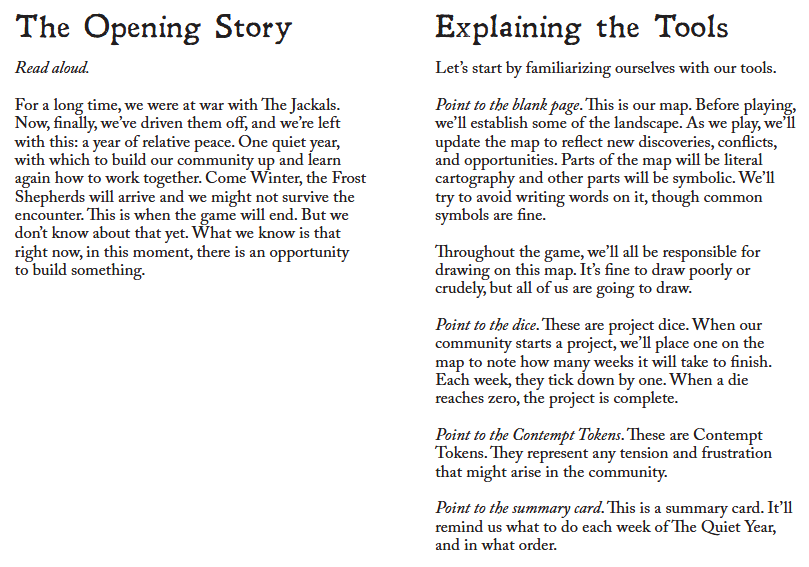
These ‘read aloud’ instructions continue for pages and pages.
The Quiet Year took a radical approach to RPG design, focusing play around drawing on a map with a set of scenario prompts on cards to structure play. At the same time, it also really likes to tell you exactly what to say verbatim during setup and explanation, and even once the game proper begins, it forbids speech outside of certain limited contexts:
In playing The Quiet Year, we must refrain from free-wheeling discussion about what to do next. There are specific mechanics in the game for discussing community issues and demonstrating our displeasure. When we play, we won’t speak out of turn or attempt to circumnavigate these mechanics. These rules work to demonstrate how difficult it is to engage the entire community in conversation, and how tensions and disagreements tend to linger across weeks or even months.
Of course, as players, you are free to ignore that. No designer can forbid you, because the game only exists by player assent. I bet most groups did not play it exactly as written. I have played The Quiet Year reading out all of the shit Avery tells you to say, and it’s kind of exhausting! I would not recommend it! Despite this, I think the game was genuinely really innovative and I’ve had a good time with the actual game. I just recommend you explain it in your own words, not ‘Avery Alder voice’.
You may recall at this point Bernard Suits’s argument that Cops and Robbers is an open game, where the aim is to keep the story going, and the constitutive rule is that you must improvise rather than read from a script. In this case, the constitutive rule is actually the opposite: you must not improvise, you have got to read from a script. But perhaps this could still be seen as lusory. If your aim is to ‘experience the story of Hamlet’, it would be more efficient to, say, watch a film version. And indeed, group script readings are not an unheard-of activity among the nerds of the world, and it seems plausible to suggest they are a type of game…
game-hacking in the 70s and 2010s
The ‘D&D is incomplete, and requires modification to work’ criticism is not so new. In the 70s, when all the players of the new game were hacking and houseruling all over the place, Peterson observes that players soon started questioning the line between heavy houserules and an original game altogether…
Whether a set of variant rules had achieved sufficient autonomy to warrant designation as an independent game also had no objective markers: as Lee Gold would advise in 1977, “If your house rules run more than thirty pages, I suggest you consider you’ve invented a new game and copyright it” (AE 29). It was not hard to hit that mark because everyone was constantly hacking the system.
Kevin Slimak, feeling “tired of trying to kludge a good game out of Gygax D&D,” decided on a solution: “Stop pretending to be playing D&D; call the game something different and rework/rewrite the rules to my own taste” (WH 5). Slimak serialized his ideas through a fanzine, but there was no great ontological distinction between that and sharing them through a self-published product. The authors of Mythrules (1978) decided after more than a year of developing variants that “it became apparent that we were no longer merely writing addenda to other authors’ rules but were actually creating an independent game of our own.”
However, at this point, there was less expectation that a game should offer something complete. “I have a strong hunch that nothing’s ever going to be more than a starting point.” wrote Jim Thomas, praising a game called Chivalry & Sorcery over D&D. People would put together composite games, borrowing mechanical ideas from wherever…
A given campaign could siphon rules from anywhere—from the D&D rulebooks, from a competing title, from the grungiest fanzine, from its participants’ sudden inspiration—and whether the players deemed the resulting game an instance of D&D or not became a superficial and almost superfluous question. Albeit, many players, like Lingard, seemed more disposed than not to call their campaigns by the name of the best-known role-playing game—the “Xerox” of the young industry. But early critical discussion vacillated between D&D and the FRP hobby in general with little evident distinction—only advocates for particular competing systems, most particularly their authors, would insist on more specificity.
Most games of this era would explicitly acknowledge their flexibility to modification. A similar ethos prevailed in the earlier parts of the story-game movement, with players offering ‘hacks’ of existing games: many of what came to be called ‘PbtA’ games were initially referred to as ‘hacks’ of Apocalypse World, which includes a chapter about the design considerations for modifying the game in its rulebook. A rather significant bulk of the indie RPGs published on itch.io are hacks of games like Lasers & Feelings. Back in the day it was so central to the movement that at one convention in 2013, there was a session called ‘literally hacking games’, where attendees could cut up rulebooks to assemble new games by collage; the results were printed as a zine.
can an RPG be played wrong?
Game designers can contain multitudes. Above, I criticised The Quiet Year for being overbearing in telling you what to say, but Avery Alder was also one of the hosts of the ‘literally hacking games’ session. (Then again, perhaps it’s notable that this game of hacking up rulebooks was formalised into a convention session run by celebrated game designers! I can see credits for who proposed and hosted the session on Avery’s site, but the zine doesn’t mention who made the hacked games.)
As for Gary Gygax, he changed his tune many times. The original D&D rules present themselves as a best-effort, and Gary seemed pretty chill about the many different variants. But in 1978, for example, he went on a tirade against modifying D&D or creating rival games, complaining that modifications would upset the balance of the game; in 1982 he cast scorn on players with house rules for not truly playing D&D:
Since the game is the sole property of TSR and its designer [Gygax], what is official and what is not has meaning if one plays the game. Serious players will only accept official material, for they play the game rather than playing at it, as do those who enjoy “house rules” poker, or who push pawns around the chessboard [without following the rules of chess]. No power on earth can dictate that gamers not add spurious rules and material to either the D&D or AD&D game systems, but likewise no claim to playing either game can then be made. Such games are not D&D or AD&D games — they are something else, classifiable only under the generic “FRPG” catch-all. To be succinct, whether you play either game or not is your business, but in order to state that you play either, it is obviously necessary to play them with the official rules, as written.
Players, if they were even aware of it, cheerily ignored this declaration; indeed, Gygax himself apparently used house-rules in his own games of AD&D. But it raises an interesting question. Can you play a tabletop RPG wrong?
can designers do too much?
OK, after all this time we’ve spent with Bernard Suits inspired by one of her arguments, it’s time to actually address the core contention of Vi Huntsman’s video. Lets get into it! Here’s the video again.
The whole video’s worth a watch, but in case you’re not in the mood for three hours on the subject, jump to chapter 11.2 ‘Ron Edwards’ where, after examining all the connections between members of the Forge and implicitly suggesting a high degree of nepotism, Vi dives into their ideology.
At issue is a similar sentiment to Gygax’s line about playing D&D wrong, expressed by Ron Edwards in the thread which led to his infamous ‘brain damage’ comments. A player questioned the rules of Sorcerer, a game about the relationship between a sorcerer and the demon they command; they brought up the example that it seemed that a character could never reliably make their demon act at the same time as themselves. Rather than simply saying ‘yes, that’s the rules working as intended’, Ron responded with a broadside arguing that the player was not just making a fundamental misinterpretation of the rules, but that the example in question reflected a lack of imagination comparable to missing a limb. The players, Ron argued, should be following the rules exactly to make up for the deficiency.
Vi interprets this attitude as saying this: players cannot come up with a good story on their own, and require a well-designed game—a product—to get them to do it properly. She zeroes in on the Forge’s dichotomy of functional and dysfunctional play.
the ABA comparison
Much of Vi’s video is informed by a comparison between the Forge theory of game design and an abusive practice masquerading as a treatment methodology for autism called ‘Applied Behavioural Analysis’. In ABA, the clinicians define behaviours that they want the child in question to exhibit or not (such as making eye contact, or not visibly stimming), and then try to create a system of reward and punishment to coerce the child into following that behaviour.
In her interview with C. Thi Nguyen, drawing on her experience in the ghoulish role of an RBT (a ludicrous jargon title that expands to ‘Registered Behaviour Technician’), Vi sums up ABA like this:
Vi Huntsman: How would you feel about a gamified daycare where you earn points by acting neurotypical—this is a daycare for just autistic kids—and you can only score points that a health insurance company can understand?
Vi reasonably calls ABA, and Nguyen calls ‘gamification’ in general, an effort towards mind control. These are notably involuntary, and carried out with the purpose of replacing the subject’s values with a system that is meaningless to them. She highlights how a theory of mind is not a concern in behaviourism; it is concerned with going through the motions for the paternalistic and dehumanising gaze of an observer, not the motivation behind it.
So yeah, our society has institutionalised a child-abuse panopticon for autistic children. Indeed, making someone ‘better’ seems to grant an almost unlimited license to abuse and traumatise them. (In passing, let me mention Joe vs Elan School and the truly horrific ‘Troubled Teen Industry’ that prevails in the USA. These kinds of child abuse, exploiting the anxieties of parents, are in fact very lucrative business.)
But what does it have to do with TTRPGs or games in general? After all, Suits made it the first word of his definition: we voluntarily submit to rules in order to enable the activity of the game. For fun! How can a voluntary practice resemble ABA? Well…
Vi’s contention is (in my words) that the Forge theory makes a sleight-of-hand in all its talk of ‘creative agenda’, substituting the intentions of the designer (expressed through reward systems in a game) for the intentions of the players, and then attempting to apply similarly behaviourist methods to use roleplaying games to make those players play ‘better’.
incentivisation
In support of this, she focuses on an element of design theory called incentivisation. Her focal point of criticism is an episode of a podcast called Stop, Hack and Roll; Vi says she has been thinking about this episode for ‘literal years’, and she recorded essentially a reaction video to it here which she excerpts in the main video essay. The reason for this fixation was that it offers kind of a smoking gun for her criticism of behaviourism in game design—because one of the two podcast hosts, Brandon-Leon Gambetta, was literally an ABA analyst, and in this episode he described the radical behaviourist view that everything can be viewed in light of behaviours motivated by rewards and incentives.
‘Incentives’ in game design is a common mode of analysis. For example, the ‘optimising the fun out of the game’ situation we analysed in the last article can be viewed in terms of ‘perverse incentives’: players realise the best way to win is to play the game in a tedious way, and have to make a trade-off in terms of the things they want. From a game designer perspective, the solution is ‘aligning incentives’: the player’s wish to play the game in a fun and varied way and their wish to win should not be in conflict.
Note however that this formulation is that the pre-existing desires of the player, when mapped to the ‘agencies’ of the game, end up in conflict! The conflict here is between different things a player might want out of a game, and the design goal is that there shouldn’t be a conflict.
But there are many cases where designs want their games to be played in a certain way. Of course we can’t stand at every player’s shoulder and suggest they try a way of playing that we think is more fun. A great deal of the design of computer games in particular is about teaching the player about how the game works and, especially in ‘linear’ games, guiding them towards a ‘golden path’—from explicit onscreen tutorialisation prompts to subtle level design which hints towards the way forwards.
I say ‘subtle’, but it can also be heavy-handed. Salen and Zimmerman discuss, in positive terms, a computerised Disneyland ride where players control a pirate ship (following an article by its authors on Gamasutra). The player is guided towards points of interest by enemy ships on a fixed course, so a goal of ‘pursue the enemy ship’ (a natural goal) naturally leads into ‘go to the island’ (the designer’s goal, since they want to lead the player to the exciting battle scene there). But if the player at the wheel ignores the enemy ships and steers their ship out of bounds, the ship will be teleported back towards where the action is. Players are generally happy with this, Katie and Eric say, because they find themselves with enemy ships to fight. (For players of computer games in general, I would say similar ‘invisible walls’ tend to be regarded as an annoying but necessary evil.)
rewards
Beyond these ‘this is where the game is’ guiderails, designers may try to influence the behaviour of the player in more abstract ways. ‘Incentivisation’ usually refers to situations where there is a part of a game or way of playing that a designer wants to invite a player to engage in, but they might observe (during playtesting, for example) that players are reluctant to play that way.
One solution is to attach it to some other mechanic, commonly called a ‘reward’. For example, a designer might place upgrade items at the end of a platforming challenge, or even just ‘you did it’ acknowledgements like achievements. This provides a Suitsian goal; the player has a ready-made structure within which to challenge this optional part of the game.
In the theory of game design, these are known as ‘extrinsic rewards’, as opposed to the ‘intrinsic rewards’ which arise from the activity itself. For example, in a game like Warframe, completing a mission might give me an item I need to unlock a new warframe or weapon; the act of running through the level is (ideally at least) intrinsically rewarding. The ‘players will optimise the fun out of the game’ maxim has a companion here: ‘extrinsic rewards tend to trump intrinsic rewards’. Players will often prioritise efficiently pursuing the ‘do A to do B to do C’ chain to the neglect of intrinsic rewards, even if the intrinsic reward was the reason they picked up the game in the first place.
This is not the only solution to ‘players aren’t engaging with the game as we intend’. Another approach might be to remove a conflicting mechanic. For example, in Dark Souls, players would often hide behind their shields instead of engaging with the more challenging timing-based prediction and dodging mechanics. Bloodborne removed shields almost entirely, replacing them with a gun that can be used to parry attacks (don’t overthink it); a description on the game’s one shield says that shields are thought to encourage passivity, so we can be pretty clear what the design intent was here.
punishments
That’s rewards, but what about punishments? In a fighting game, if a player does something that leaves them open to attack, we speak of the other player ‘punishing’ the other player’s move, e.g. a ‘whiff punish’ when the player’s attack doesn’t land. The concept of punishment in game design is similar: something bad happens to your position in the game which you would most likely prefer to avoid.
Later Souls games brought shields back, but throughout the series there is still a mechanic that makes turtling behind a shield risky: if you run out of stamina when blocking, you get guard-broken, and potentially take a lot of damage, which is a form of ‘punishment’. You also get ‘punished’, of course, for misreading an enemy’s attack pattern and rolling or attacking at the wrong time. The ‘punishments’ are not too drastic; most attacks do not kill the player character immediately, so there is leeway to recover using the Estus Flask. But if you take too many hits, your character dies and you will need to retry the area or boss, a harsher ‘punishment’.
This is what designers would consider a ‘well-balanced’ structure. ‘Don’t get hit’ provides motivation to learn to predict boss attacks, but there is enough leeway that the game does not become frustrating.
‘Rewards’ and ‘punishments’ exist to align the optimal pursuit of a goal (e.g. kill the boss) with the intended activity of the game (e.g. learn to read attack patterns and dodge at the right time). While the language seems strangely carceral, it is hard to imagine a Suitsian, goal-driven game which doesn’t have these features. (Of course, we could call them ‘progress’ and ‘setbacks’, but it doesn’t really capture the visceral feeling of getting hit in an action game.)
For Salen and Zimmerman, the rapid communication of the effect of their actions is vital to the pleasure of a game, along with the gradual ‘same-but-different’ evolution over time. In Chapter 24 of Rules of Play, they present this pleasure as something that even starts to feel dangerous, that ‘entrains’ us in the patterns of the game. Behaviourism does indeed come up. After summarising Pavlov and Skinner’s work on conditioning, they very briefly discuss how positive and negative reinforcement factors into games, remarking…
Games are systems of meaning. It is within their artificial boundaries that rewards and punishments are interpreted as positive or negative and gain force to shape player behavior. Operant conditioning reminds game designers to pay attention to the way a game encourages or discourages certain behaviors. In creating rewards and punishments, game designers shape the actions players are likely to take in the future. This is an important game design concept, especially in digital games, where the program automates so much of the play activity.
The next sections rapidly examine different types of rewards (after Neal and Jana Hallford) and conditioning theory’s taxonomy of fixed vs. variable reinforcement; they cite a passage from Gabe Newell discussing how the pacing of Half-Life was adjusted to keep novel situations flowing. This gets compared with Mihaly Csikszentmihalyi’s theories of the ‘flow state’, and with that in mind, they discuss how to balance challenge and boredom. And so on. Lots of theoretical tools!
Salen and Zimmerman’s goal is to evoke pleasure and more generally ‘meaningful play’ from games. ‘Punishments’ for them are a way to create a tension that eventually leads to greater pleasure. This is pretty noble, right? But it is kind of spooky to see operant conditioning invoked towards this end. Perhaps Vi is onto something when she suggests designers stray into seeing game design as mind control.
In the decades since these ideas began to be discussed in game design circles, the language of game design has filtered out into the wider world of players, who will happily talk about questions like whether a game’s ‘difficulty curve’ is too steep or erratic. Players will complain when they feel a game is unbalanced, and come up with their own suggestions to fix it.
board and card games
So far, so computer game focused. Computer games are a curious case because there is a very clear separation between the game developers who define what the game is, and the players who experience it (modding notwithstanding!). This is not to say there is no ‘magic circle’ when playing a computer game, far from it. A computer game is in a sense just an object, one which strongly suggests a certain game to play with it, but it’s the player’s choice to take the game on those terms or substitute some others, like speedrunners practising a trick to clip out of bounds or Quake players using the game to make rocket jump videos.
However, to a much greater extent, board games, card games and sports rely on the players themselves to instantiate the game. In many cases, the rules are learned by tradition. Who wrote the first version of the game of chess, or (to pick a card game at random) Whist? It’s lost to history. For Whist, a version of the game was codified in 1742 and again in 1862, but it existed well before then, diverging from the game Triumph at some point in the 17th century.
This means that a designer of a board game has a much more limited control over how players will approach their game. They can issue instructions, which are maybe more like requests. The rulebook must be written with the intent of guiding the players to set up the game and play it. Players might forget to use a rule, or invent house rules.
Is the language of reward and punishment a less natural fit for this setting, where there is usually no automaton? We could say that a player of Ticket to Ride is ‘rewarded’ for grabbing a bottleneck route by making it easier to build their lines, or ‘punished’ for focusing on saving up cards for a long line and missing the chance to build a short one, but I think this is unusual. These ‘rewards’ and ‘punishments’ are more towards the end of ‘emergent from the system’, not specifically created as arbitrary couplings to push a specific behaviour.
Which is not to say that designers don’t make some effort to tune how their mechanics connect to the ultimate Suitsian goal, such as the ubiquitous victory points systems in European-style games…
Thinking about it, the main place I’d think to apply the concept of a ‘reward’ in a board game is a mechanic like the one in Pandemic Legacy, a cooperative game played over multiple sessions, where the advance of the illness is controlled by an automatic system controlled by cards and conditional events. Here, winning one game gives the players a small bonus in the next one and advances their progress towards the main goal. And characters can also gain lasting injuries in certain situations, making them less effective, so the players must balance this risk.
This automatic system is definitely something we can parse as an extrinsic ‘reward’ and ‘punishment’ system: the players are motivated to pursue victory in each game, and avoid dangers. But alongside them, the game has several ‘negative feedback’ mechanisms (negative in the cybernetic rather than behaviourist sense): if they do well, the players have fewer special cards in the deck, and if they do poorly, they gain more. You can imagine the game designers tweaking all these knobs to balance the game and try to make sure most groups have a satisfying trajectory.
does this have a place in roleplaying games?
OK, that’s a really long review of the role of incentives in game design theory, let’s get back to Vi.
Discussing behaviourism in game design, Vi quotes Brandon Gambetta as talking about the common player sentiment of wanting to ‘punish’ bad behaviour at the table in-game. (For example, if a player murders an NPC, you might have the guards come and arrest them. I can attest that this sort of thing was definitely discussed. The correct answer is “don’t try to solve out-of-game problems with in-game solutions”, but that advice wasn’t always followed.) Brandon says this is a very weird thing to want to do to your friends:
Brandon Gambetta: Right. And a lot of the older games have a lot of things about punishing your characters. Like, there are so many games that just say, “Uh, hey if your players are being a pain, punish them with this!” And that’s crazy, we’re friends getting together wanting to do something.
Vi agrees, but adds that Brandon’s preferred approach—of incentivising them with small rewards like giving the player a cookie—is also a really messed up thing to try to do to someone. (She brings up an episode of The Big Bang Theory which made a whole episode out of this premise.)
Later, Vi catches a moment in the podcast where the host says the players already have a ‘functional’ way of playing, but they want to replace it with a ‘more functional’ one, which is immediately translated to “what we want them to do”. She says that, compared to board games which define entirely new spaces of actions where players don’t have pre-existing values, roleplaying is another matter…
Vi Huntsman: The reason ABA fits so well with game design for tabletop roleplaying is because people DO have pre-existing values for storytelling. Maybe even specifically storytelling in tabletop roleplaying games! And if you try to intuit their values by looking at the rules of the game they’re playing, it might look like those values are baaaaaad… and then you might take it upon yourself to impose new, better values on them.
She quotes various examples of these two podcasters making various assumptions that they can understand how games work based on the incentive/goal structures—for example, they argue (bafflingly) that players would be motivated to take a combat-suboptimal ‘author stance’ story beat like having their wizard punch someone in Dungeon World, but not in D&D.
Well, some podcasters are kinda stupid, what else is new? Vi argues that a central goal of the Forge design school is to try to shape the players’ behaviour in games through this kind of incentive structure, thus shaping them to be better players in general.
Gambetta and Malloy take this idea to its natural conclusion by saying that you should design games that contain, quote, “Pointed, leading bribery to trick players into reinforcing [the actions that you want as the designer], so that they take them even when the bribe is gone.” They are literally saying their goal is to secretly alter your long-term storytelling values.
OK, skipping to part 11.3, Vi presents a nice helpful summary of what she’s arguing:
Forge ideology is a mind control facility that never worked in the first place, because it’s really just a smokescreen for using behaviorism and board game logic to market systems with the promise that systems create reproducible experiences
With the case in point being Root: The RPG, by Magpie Games. She argues that the one useful part of Root: The RPG, the only which doesn’t just tell you what sort of experience the game is going to enable and then take credit for enabling that if you go ahead and create it, is the adventure ‘Gelilah’s Grove’ (though she doesn’t say much about what’s valuable in this adventure). Later, near the end of the video, she likewise praises adventures as the sort of thing that is useful to provide:
From here on out, I’ll be searching for that future. I’ll be looking for books that lean into that playfulness. Books that can be engaged with playfully. I want cities, factions, classmates, neighbors, plants and animals, villages with problems, and yes, dungeons. We can write this stuff—we can write adventures that aren’t railroads, we can write avatars that engender avatar identification, we can write compelling, specific details and then we can let go of it all, trusting that the players will create a story of their own through the simple act of moving forward.
To Vi, writing books of rules designed to shape a certain kind of play in a TTRPG is an attempt to alienate us from our own creativity and invite the corpo overlords to breathe down our neck at the table. A heavy charge!
is Vi Huntsman right?
I think it’s hard to disagree that:
- ABA is astoundingly evil
- ‘gamification’ is pretty sinister too
- game designers do frequently cite behaviourist theory in their work
- at least some designers at the Forge aspired to ‘better’ roleplayers and cure them of the ‘dysfunctional’ play typical in D&D and Vampire: The Masquerade
I’m not sure if I agree that the main mechanism that the Forge designers used to pursue this aim was by shaping socially worthwhile incentives into their roleplaying games.
Certainly, some of them seemed to believe in this goal. (Ron, for example.) But if you read Vincent’s design notes on Apocalypse World, his major interest seems to be exploring a model of interpersonal conflict.
The game that put Vincent on the map, Dogs in the Vineyard, had a similar focus: its core conceit is that every conflict in the game is framed as an escalating ladder of violence. In Dogs, your only option to get out of a losing position is to threaten worse violence or back down. It’s an interesting concept. Not the one true model of roleplaying games, but certainly a game I’d quite like to explore at least once.
This doesn’t seem to be inculcating positive social values into players. Indeed, some of Vincent’s games seem downright misanthropic. In a way, this is what makes them interesting games: they are quite weird.
Nevertheless, I think it is true that many story games can feel quite overbearing in pushing the designer’s finger onto the scales of how you approach a game. Avery Alder’s games often feel like this (particularly e.g. Dream Askew or The Quiet Year). I am certainly with Vi as far as feeling that games that try to teach you to be a better person are often heavy handed and simplistic with it.
freeform in the 70s
I’ve quoted a few passages from the Intermezzo chapter of The Elusive Shift already, but let’s note another one. Frustrated with the hodgepodge of not-necessarily-well-designed systems, some players started trying to leave more to player and referee discretion. D&D co-creator Dave Arneson, for example, was said to run a more or less freeform table. Greg Costikyan in 1979 wrote a satirical reductio-ad-absurdum game (in a similar manner to typwrtrmky’s satire game) called Lord of the Dice, which recommends referees give each character completely arbitrary statistics and to resolve things by rolling dice until a ‘high number’ or ‘low number’ shows up.
In 1979, Greg Stafford introduced a scene in his Glorantha game where players would step out of their usual roles to play a council of faction leaders dealing with the result of the party’s actions. There were no real rules, just contextual details of what each character was supposed to know. The result was apparently a huge success, and became a recurring feature of the campaign, one that could take some of the ‘referee burden’ away from Stafford.
These examples anticipate the 2010s developments: the freeform aspects of games like Fate, the diffusion of narrative authority, the ‘rules light’ and ‘rulings over rules’ games.
Peterson ends the chapter like this:
The emergence of “free form” as a recognized style of game gives us another clear data point on how early adopters understood role playing and the practices that encouraged it. Some, like Jones, clearly thought that when you took away the system, role playing is what remained—that the obliviousness to system recommended by Sandy Eisen was the core of role playing, and it hardly mattered what was going on behind the referee’s screen. But the century-old example of “free” Kriegsspiel illustrates how players can find the lack of system arbitrary and disempowering, to the point where there is not enough of a game left for people to consider themselves players. Predictably, a backlash would follow, especially given how many people stood to lose if it turned out, as Thomas put it, that new rules were not going to make much difference. An entire budding industry depended on him being wrong. But this also had disquieting implications for anyone hoping to articulate what makes something a role-playing game: namely, that those qualities might not be extractable from systems and rulebooks. What makes something a role-playing game might instead live in the state of play. But then the entire project of developing rules to encourage role playing would seem to be in grave doubt.
In 2025, with the space of RPG rules far more widely explored, it seems like it might still be in grave doubt.
so who’s responsible for what, at the end of the day?
OK, so, we’ve examined two strong stances on the role of game design in RPGs. Typwrtrmnky argued that game designers are abdicating their responsibility to provide a functional game, and leaving the work of finishing a game to the DM. And Vi Hartman argued that ‘rules-heavy’ game designers, like Magpie Games, are trying to overconstrain and claim credit for our free creativity at the table in pursuit of marketing a reproducible experience.
There is actually an interesting point of agreement between the two. Both agree that game materials aren’t providing what they should be.
Last year, in the what’s the book for?, I responded to Vi’s video by examining the different social functions a written rulebook can have in enabling the activity of roleplaying. The cases I came up with were…
- a ruling reference (‘RPG book as legal system’)
- a grab bag of interesting prompts (‘RPG books as inspiration in the moment’)
- a machine to guide you to a specific experience (‘RPG book as auteur blueprint’)
- an excuse to make up a story together (‘RPG book as seal of permission’)
- a way to unify the subculture (‘RPG book as common reference’)
I could probably think of more but this is a reasonable starting point. When you buy ‘an RPG’, you are getting a book of instructions which claims to provide at least some of these things if you follow them.
To play an RPG, you need a few different things…
- a sense of the sort of story that players are going to be telling together
- a fictional scenario to inhabit, which may be defined in advance or invented during the game
- characters for the players to control
- rules and procedures that players assent to, formal or informal
- a shared digital or physical space to play in
- time (this is the hardest part lmao)
Any of the first four things may be provided by either the players themselves or a third-party game designer. That designer does not have to be someone who wrote and sold a book specifying a complete game. For example, the ‘hexcrawl’ structure faded out in the 80s, but made a comeback in the 2010s via blogs such as The Alexandrian. It’s a rules structure which can be grafted onto any RPG that involves travelling about.
The ‘sense of the sort of story’ does a lot of heavy lifting here. One really sharp observation made in System Shop—forgive me, I don’t remember which episode!—is that RPGs which aim to replicate a particular show or well-defined genre often don’t really need rules to try to capture specific episodes. Once the players know the sort of thing they’re going to come up with, they can pretty easily follow the familiar beats and narrate it freeform based on their common reference point. Ultimately, the biggest thing the ‘game’ is offering them is a suggestion: wouldn’t it be cool to tell a story based on this show?
This may be true of many other games we’ve considered as well. In part 5 I talked briefly about Kagematsu (2009), a game in which one player plays a ronin and the other players control townswomen trying to court him in the hopes that he’ll settle down and defend their village from a threat. Well, that sentence alone may well be enough to play the ‘Kagematsu scenario’, perhaps as an episode within a broader story! It’s a great premise. Perhaps the game’s rules would make for a compelling collaboration, but the same might also be true with other rules, or no explicit rules at all and merely the judgement of the players.
But yes, in general, roleplaying games are composite structures. Books might provide different combinations:
- Electric Bastionland (Chris McDowall, 2020?) provide many tables of quirky characters and objects, but leave the broader setting loosely sketched and the rules fairly brief
- Dungeons & Dragons, in later editions, defines a precise and intricate rule structure, and a variety of potential setting elements such as monsters, but leaves the premise and setting details up to the players and DM
- Hot Guys Making Out (Ben Lehman, 2013) provides a very specific premise and characters, very little further detail on the scenario, and a procedure for the game which gives it pacing and structure (using cards).
- The Caverns of Thracia (Jenell Jaquays, 1979) provides a premise and detailed scenario with characters and maps. It does not specify procedural rules, since it’s assumed you’ll be using it together with an existing system such as D&D.
- Empire of the Petal Throne (M.A.R. Barker, 1974) was the very first game to provide a detailed RPG setting, as well as novel mechanics such as a skill system. As such, it specified a lot more than D&D. I assumed it doesn’t supply a scenario, but I was mistaken: it at least has a standard starting point where the characters are travellers ‘fresh off the boat’ in a specific city. [2026 edit: turns out Barker, writing under a pseudonym, was an actual full-on nazi?? Didn’t know that at the time I wrote the article, and I don’t know when exactly he became a nazi, but having learned it, feels like it important context to add. Eesh.]
Blog and forum posts tend to offer more modular pieces, to be grafted into whatever game you like.
So, this hints at the murky reality underlying any claim that roleplaying games are things found in books!
Unfortunately the answer to ‘what should a book provide’ is not something that can be answered in any clear-cut way. I do think it’s important for the designer to remember this, though: ultimately, the players will butcher your game for parts and move on. Very small innovations, like Apocalypse World’s tool of asking questions of the players to fill in details of the setting, can have a huge impact even if the player mangles or rejects outright your carefully tuned engine.
OK, I’ve spent this whole series so far trying to thoroughly consider design questions from as many angles as possible. Now’s the bit where I express an opinion.
improvisational game design is actually the fun bit
I’ve tried to present typwrtrmnky’s critique in as fair a light as possible, but if you’ve read the game hacking polemic I wrote a year ago, you can probably guess where I stand on this question.
For me, a huge part of what’s fun in RPGs is experimentation. I love to tinker with games. I love to make stuff up. If a game gives me a list of suggested names, unless I’m at a con game in a huge hurry, I will almost certainly come up with my own name! I find playing in highly detailed settings like Shadowrun or Eclipse Phase quite difficult because it gets in the way of defining some part of the setting for myself. (Totality of Shadowrun experience: I come up with the idea of having bug-themed magic powers. The GM ums and ahs and is like, yeah that’s probably not a good idea in this setting. Somewhat discouraged, I come up with something else, I forget what. The game never ends up happening.)
The last time I ran a game, I used Apocalypse World, and the game ended with the player characters overthrowing me as MC (building on a one-line prompt the game offered about the thing beyond the psychic maelstrom). I used the MC principles in-character to describe the motivations of the egregore orchestrating the world’s misery. That is not really something that Apocalypse World makes any rules affordance for, and it would cheapen the moment if it had. At the same time, this game moment was directly responding to the rules of Apocalypse World.
The next time I run a game I intend to create my own custom system for the specific things I find interesting to explore in that game, and of course I will have to iterate on that system as we play. I will borrow liberally from whatever sources come to mind. I have no aspiration to publish it. But I don’t think any part of the activity of roleplaying should be off-limits for tinkering.
In this, I find some fellow-travellers in the 70s…
People seemed to understand [the spectrum from hacking to new games] in perspective: by 1979, we can see the author of a self-published volume such as E’a admit that, “basically, I’m just like a lot of you out there, one player with a few ideas and a lot of good friends willing to help me over the rough spots. I believe that by now it’s almost impossible for any system on this type of gaming to be totally different from all the others.”
This consensus about open-endedness blurred the borders that separated one system from another, raising fundamental identity questions about games: we see someone such as Gordon Lingard say in A&E 50, “I’ve started running D&D using Runequest rules,” though he casually posed that fraught proposition before introducing a system for social skills he had added himself that covered bribery, investigations, influence, business acumen, and so on. Which system was Lingard really using? Was it TSR’s or the Chaosium’s or his own?
In that sense, I find Vi Huntsman’s preference for adventures quite surprising. Adventures can be nice sources of inspiration—‘oh, I never thought of doing it like that’. But at the end of the day, I’d rather build the playground myself.
But that’s just me…
the inevitable bit where I talk about my current RPG
Let’s consider the game of D&D I’m currently playing, run by Alex. This has been one of the best RPG experiences I’ve had. Some of the ingredients that go into it…
- Alex’s inspirations are more along the lines of Michael Moorcock and Mervyn Peake than the the typical palette of D&D 5e
- Alex has a real talent for coming up with colourful NPCs and compelling scenarios and voicing them in the moment, so her world is an absolute joy to explore
- Alex is confident remixing the rules of D&D, e.g. using an existing monster statline for a different creature, or using a third-party monster
- before the game started, we talked about the aesthetic vibe we were going for (with memorable comments like ‘barbarian revenge inspired by The Fall’, ‘you’d be more likely to meet a bug person than a dwarf’).
- each player took some responsibility for cooking up the part of the setting relevant to their backstory. if Alex hands off narrative authority, we’re comfortable answering it. mostly it follows the traditional D&D roles of the DM assuming narrative authority over the world and the players their characters, but we can mix it up as we need to.
- we have a similar amount of enjoyment across the group for both thinking about character motivation and roleplaying and combat scenarios. the combats are nearly all significant setpieces.
- all the players are experienced roleplayers who know each other well. this helps with pacing, and judging what will interest the other players… plus all the injokes that accumulate over years of friendship
- the pace of events is slow enough that it gives Alex lots of time to cook up scenario-specific stuff between sessions
There is absolutely no way a book could provide all of this, or even if it did, that it would sing as well as it does in the hands of the scenario’s creator. A huge part of the appeal of RPGs for me is playing with my own stuff and the stuff my friends made up.
In that regard, RPG-book use case 2, ‘a grab bag of interesting prompts’, is probably the best thing that a game can provide me. I want the game to give me something that I can twist, reinterpret, and put my own spin on. The joy of RPGs for me is the push and pull of collaborative storytelling, where you never quite know what will come out of the alchemical combination of your ideas and someone else’s.
Which isn’t to say that game books provide nothing. I learned a lot from Apocalypse World—not because of the game’s incentive structure subtly morphing me to play differently, but because I read the book and thought ‘wow, I didn’t know you could make a game like that’. I think an interesting game design blasts open the door of assumptions that you didn’t even know you were carrying and then steps back to leave room for you to iterate.
I think that’s more than enough wordcount. In part 7, let’s try and bring this together, and I’ll look at some examples of game design that I think are cool—not as complete ‘games’ in their own right, but as pieces which you can use in your own game for whatever purpose you see fit. Nevermind, it turned out there was more philosophy to get into! Next time we come back to the idea of ‘play’.
Comments